HUB — Third-Party Marketplaces as a Demand Channel
Use major marketplaces as a demand source instead of competing head-on with them
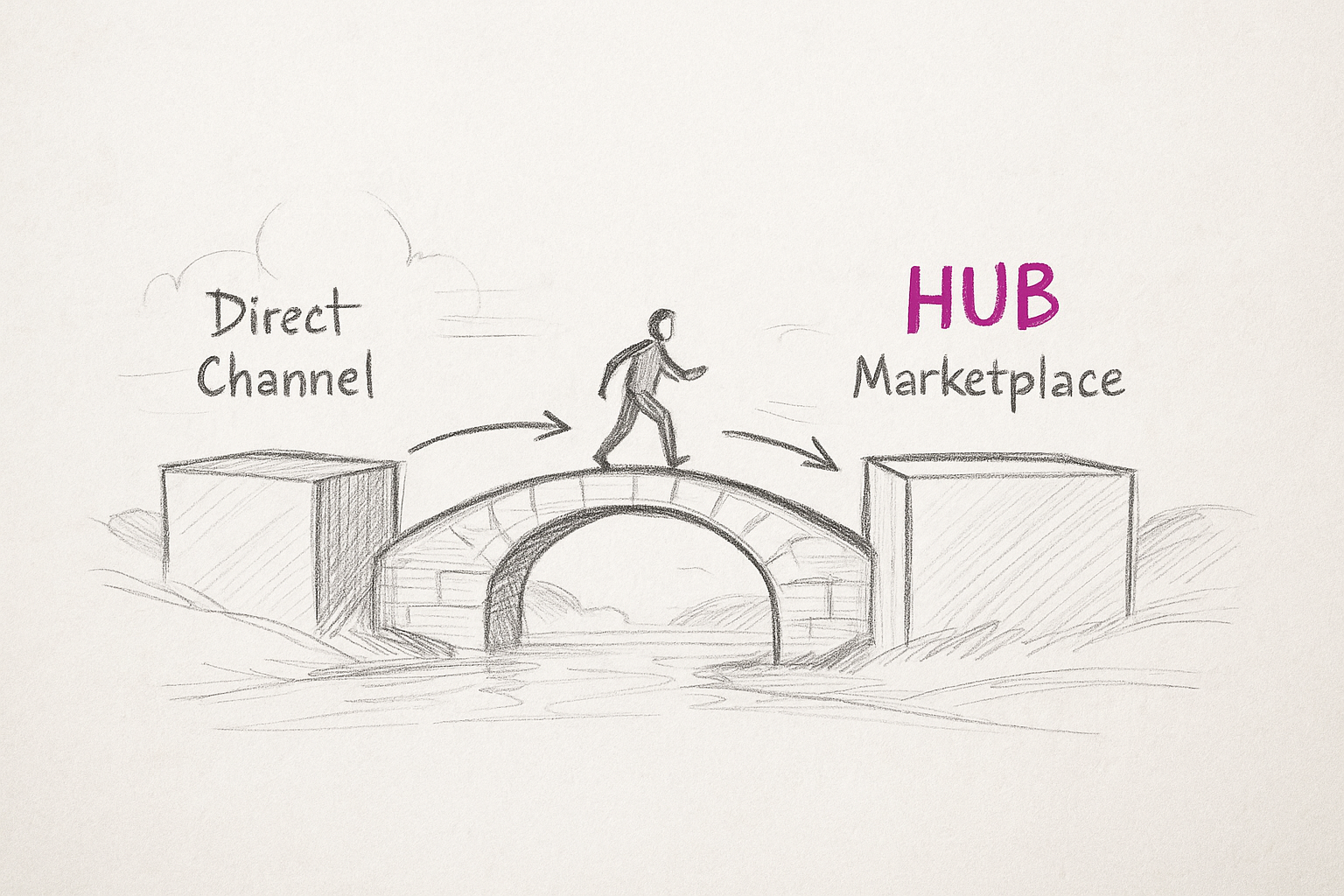
Your Direct Channel Is Losing to the Marketplace, and the Answer May Not Be What You Think
TL;DR
- Third-party marketplaces concentrate demand you won't recover simply by investing more in your own channel.
- The right thesis isn't "direct channel versus marketplace": it's using the marketplace as a demand source and your own channel as where margin is built.
- Without price governance and differentiated commercial terms by channel, operating in both environments simultaneously erodes margin on both sides.
- The decision about when and how to price in each channel needs to come before any automation or technical integration.
Why do so many well-structured B2B operations keep losing volume to platforms they don't control?
You invested in a proprietary portal, trained your sales team to migrate orders to digital, and reduced customer acquisition costs. The channel works. And yet, a meaningful portion of your customer base keeps buying on third-party marketplaces, at a competitor's price, without going through your rep.
The most common reaction is to fight for that presence with more budget, more features, more discounts. The second most common reaction is to ignore the marketplace on principle, as if it were the enemy by definition.
Both responses start from the same flawed premise: that the marketplace is a channel competitor. It isn't. It's where part of your demand already lives, and will probably keep living.
The right question isn't how to pull the buyer away from there. It's how to make that presence work for your operation, not against it.
The marketplace as an entry channel, not a terminal threat
Large marketplaces have something most proprietary B2B portals still don't have at scale: qualified, recurring traffic with declared purchase intent. That traffic took years and billions of dollars to build. It makes no economic sense to try to replicate it from scratch when you can use it as an entry point.
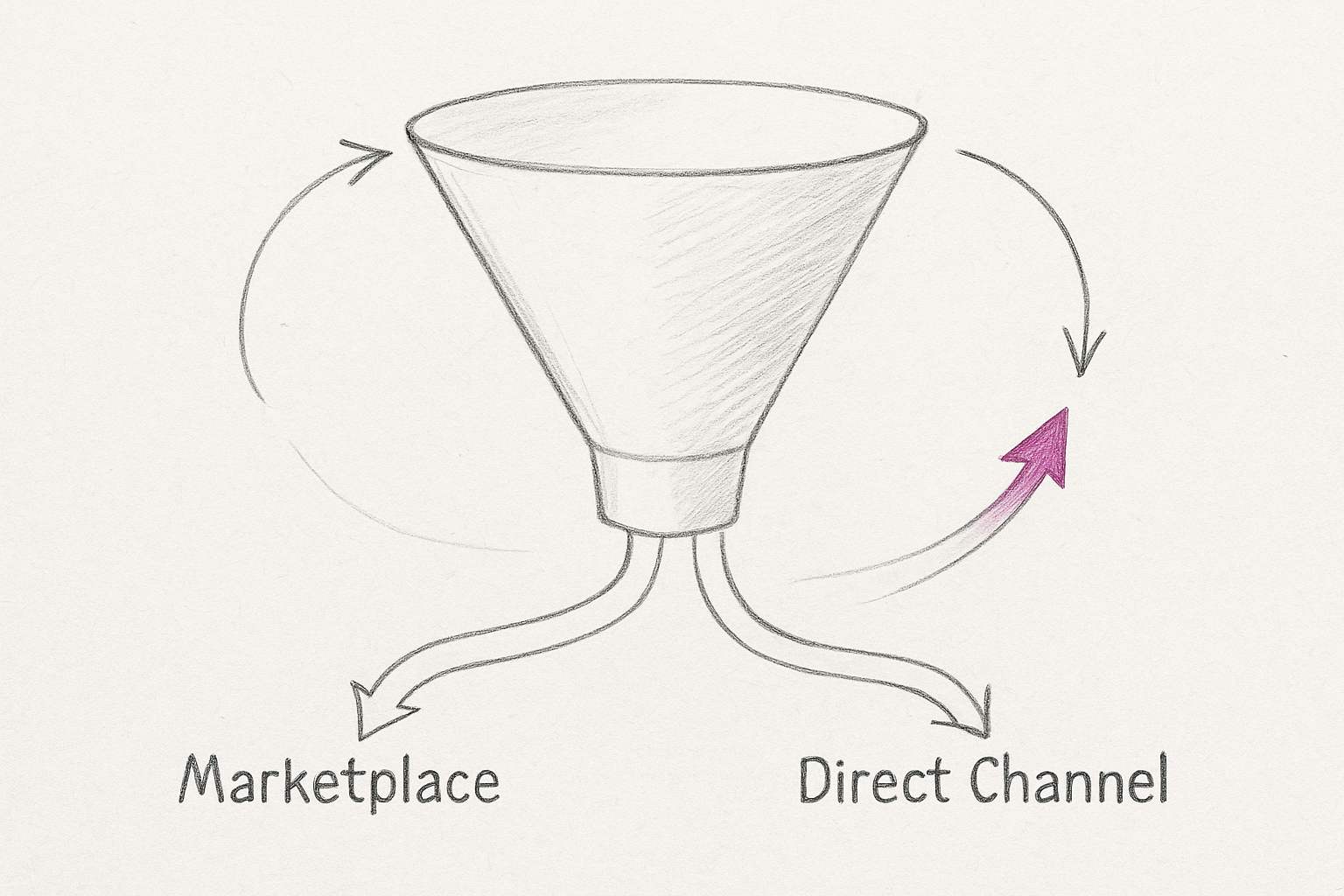
The logic that starts to make sense for more mature operations is different: be present on the marketplace to capture demand you wouldn't reach otherwise, but design the journey so that the real commercial relationship, with negotiated terms, credit, purchase frequency, and protected margin, happens in your own channel.
This isn't a new idea in B2C. In B2B, however, it runs into a structural obstacle: operations aren't set up to differentiate the experience by channel in a way that makes financial sense.
The buyer who arrived through the marketplace and migrated to the proprietary portal needs a concrete reason to stay. Not an aesthetic reason. A commercial reason: contextual pricing, payment terms, inventory visibility, order history. If the proprietary portal delivers the same thing as the marketplace, without the added convenience the marketplace already has, the buyer goes back there on the next purchase.
The cost nobody measures with the same discipline as CAC
There's a data point that consistently surfaces in distribution operations that have evaluated this equation closely: the cost of processing an order after it arrives frequently exceeds the cost of acquiring the customer who placed it.
The CAC of the digital channel, amortized across the active base, tends to be low. What isn't measured with the same discipline: manual discount approvals, credit checks over email, discrepancies between the quoted price and the invoiced price, billing rework, a sales rep calling to release the order. Each of these steps carries a real transaction cost, as reflected in CWS internal diagnostics (LI-044): person-hours, release latency, errors that turn into credit memos, customers who abandon before completing the purchase.
When an operation opens one more channel, whether an integrated external marketplace or a proprietary portal, without resolving this internal cost, it isn't scaling. It's multiplying the bottleneck.
What separates a hub strategy from scattered presence
Calling the marketplace a "demand channel" without the right structure behind it just renames the problem. What makes the hub approach work in practice are three elements that need to be defined before any technical integration:
Differentiated terms by channel: the price and conditions a buyer sees on the marketplace and what they find in the direct channel need to be deliberately different, in a way that incentivizes migration without destroying margin on the marketplace side. Identical pricing across all channels, as diagnosed in CWS diagnostics (LI-029), isn't a policy: it's the absence of governance disguised as fairness.
Decision criteria before automation: any integration with a third-party marketplace places part of the negotiation logic inside an infrastructure you don't govern. What happens when the platform changes its pricing rules, Buy Box algorithm, or visibility settings? Decisions about minimum margin, SKU substitution, and payment terms need to be structured beforehand, not dependent on the platform's configuration.
Traceability of what's being negotiated in each channel: without real-time visibility into what's being approved and under what conditions, the sales manager can't assess whether marketplace presence is generating net contribution or just volume without margin.
A distribution operation described in CWS diagnostics (LI-043) illustrates how this reasoning applies in practice: by programming commercial terms by segment and time window, the manager was able to monitor in real time the impact of every concession made, without needing additional media spend to grow conversion. The mechanism wasn't an automatic discount. It was decision structure.
The cost of inaction
Operating on the marketplace without a hub strategy carries a cost that accumulates silently:
- Volume grows in the channel you don't control, under terms defined by the platform's algorithm.
- The buyer has no incentive to migrate to the direct channel, because they find no differentiated terms there.
- The sales team competes against the price showing on the marketplace, often without a defined floor for how far they can go.
- Margin dissolves in the process, not in the market.
Principles that guide operations that have resolved this equation:
- Channel is distribution; governance is yours. The distinction between where demand arrives and where margin is built must be intentional.
- Contextual pricing by channel isn't operational complexity: it's the acknowledgment that different buying profiles carry different service costs.
- Decisions about commercial terms come before technical integration. Automating without governed rules amplifies the error, it doesn't eliminate it.
- Marketplace presence only delivers net results when internal transaction costs come down alongside it.
Frequently asked questions
Does it make sense to be on the marketplace if it's going to cannibalize my direct channel? It depends on the differentiation of terms. If the marketplace and the direct channel offer exactly the same thing, there is cannibalization. If the direct channel offers conditions the marketplace structurally can't replicate, credit, purchase frequency, order customization, then presence in both environments is complementary.
How do I decide which channel gets which commercial terms? The logic starts from the cost to serve and the risk profile of each channel. A recurring buyer with predictable volume and low credit risk has a different profile than a spot buyer. Commercial terms need to reflect that, with auditable and traceable criteria.
What if the marketplace changes its platform pricing rules? That's exactly why the decision logic around minimum margin and approval conditions needs to live in your infrastructure, not in a third-party platform's configuration. The channel is where demand arrives. Governance is where you define what you accept.
Who already lives this
"We work with B2B solutions on CWS"
, Leonardo C. (verified reviewer, automotive sector, company of 1001–5000 employees), via Software Advice (https://www.softwareadvice.com/product/546664-CWS-Platform/).
A case that illustrates this
The LI-043 record in the CWS archive describes a distribution operation that needed to run segmented promotions by channel and region without margin erosion. The mechanism that solved the problem wasn't an automatic discount: it was commercial terms programmed by segment and time window, with real-time visibility into the impact for the manager. Conversion increased without additional media spend. What changed was the decision structure, not the volume of investment.
About this publication
The Cost of the Sale is CWS Platform's publication on B2B commercial operations: where margin is formed, where it dissolves, and what separates an operation that scales from one that only grows in volume. CWS Platform is a B2B Commerce Platform for Governed Negotiation.
Sources
- LI-044 (CWS archive)
"The support model is differentiated — the project team actually understands B2B complexity and stays close throughout implementation."
Want to see this in your operation?
Real B2B operations already run on it.