Is Your Partner Integration Moving Fast Before It’s Ready to Scale?
Early governance, technical support, and post-launch feedback keep speed from replicating operational failures.

Are Your Partner Integrations Moving Faster Than They’re Ready to Scale?
TL;DR
- Partner integrations can move faster when technical support and governance are involved from the earliest stages.
- Launching an integration does not mean the process is ready to be replicated.
- Post-launch feedback makes it possible to improve the workflow before exceptions become standard operating procedure.
- The goal is not to add more controls, but to define decisions, responsibilities, and criteria before automating and scaling.
How Can You Accelerate Integrations Without Multiplying Operational Failures?
The pressure on B2B sales leaders is familiar: onboard partners quickly, preserve the deal experience, and prevent the operation from depending on manual intervention for every order, commercial term, or exception.
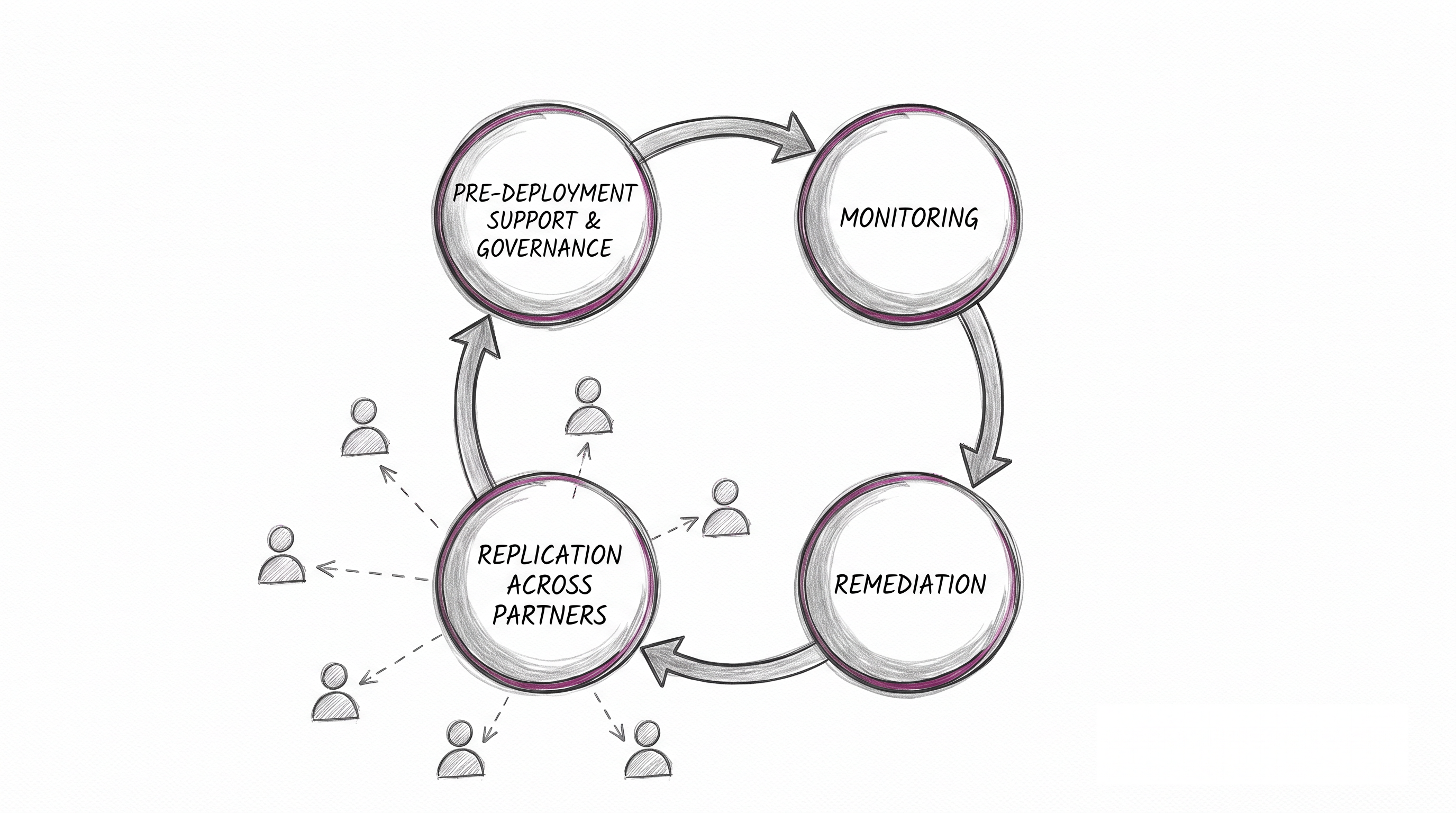
The risk emerges when speed is measured only by the technical timeline. The connection may be complete, data may start flowing, and the workflow may go live. Even then, fundamental decisions may still lack clear rules.
Who approves a nonstandard term? How should a fix be prioritized? What needs to be documented? Which lessons from the first implementation should be incorporated before the next one?
In feedback forwarded by luiz.machado.ex@pirelli.com, the principle was summarized directly: partner integrations can move faster when technical support and governance are involved from the earliest stages. The same feedback emphasizes that post-launch listening helps incorporate improvements before the process is replicated.
The thesis may sound simple, but it changes the execution model. Instead of treating governance as a control layer added later, the company makes it part of the operating design. Instead of viewing launch as the finish line, it recognizes that the first cycle generates the information needed to determine whether the process can actually be repeated.
The Technical Timeline Does Not Capture the Full Risk
A B2B integration connects more than systems. It connects commercial policies, responsibilities, data, exceptions, and decisions that may previously have been spread across sales reps, managers, technical teams, and partners.
When these elements are not addressed early, technology may simply move ambiguity faster.
That does not mean every scenario must be anticipated before launch. It means the company must establish how it will handle situations that have not yet been anticipated. The distinction matters: a governed process does not eliminate exceptions, but it does determine who decides, what information they use, and how the resulting lessons feed back into the workflow.
Without that design, technical support tends to become involved only when a problem occurs. Governance also arrives late, usually to control an operation that has already accumulated habits, workarounds, and dependencies.
The result may look like speed at first, but it creates additional work when the company tries to add partners or increase transaction volume.
Early Technical Support Reduces the Gap Between Decisions and Execution
Bringing technical support in early should not mean giving technology ownership of commercial decisions. Its role is to make operational dependencies visible while there is still time to adjust the design.
A commercial rule may sound clear in a meeting but reveal ambiguities when it must be translated into a workflow. An exception considered rare may require a recurring decision. Information available to one team may not be accessible to the partner when it is needed.
By involving technical support and governance from the beginning, the company can identify these tensions before turning them into automated behavior.
Decision governance should come before automation. Otherwise, automation gives technical consistency to a process that may still lack operational consistency.
This discipline also prepares the company to use artificial intelligence responsibly. AI becomes more valuable when decisions, context, and corrections are documented. Without that foundation, more automation will not solve the absence of clear criteria.
Launch Does Not End the Process Design
Post-launch listening is the second component of the thesis.
Once an integration is live, evidence emerges that was not available during planning. The partner encounters friction, the internal team identifies redundant steps, and exceptions begin to reveal their frequency and impact.
Listening during this period does not mean keeping the process in an indefinite pilot. It means establishing a deliberate cycle of observation, correction, and decision-making.
Before replicating the integration, leadership should be able to answer:
- What corrections were required after go-live?
- Were those corrections incorporated into the process, or do they still depend on manual intervention?
- Did ownership of any decisions change?
- Were exceptions documented in a usable format?
- Will the next partner receive the original workflow or an improved version?
- Is there an explicit standard for determining when the integration is ready to replicate?
Without these answers, a quiet risk develops. Each new implementation may carry forward problems from the previous one while adding its own unique requirements. The operation grows, but its ability to explain how it works declines.
The Cost of Inaction
Delaying governance does not preserve simplicity. It only moves complexity to a stage where fixing it is likely to involve more people, more partners, and more live workflows.
Inaction can take several forms:
- Technical support operates reactively instead of helping design the decision process.
- The sales team fills process gaps with messages, spreadsheets, or parallel approval workflows.
- Post-launch corrections are not incorporated into the standard used for future integrations.
- Exceptions remain stored in the memories of specific employees.
- Leadership does not distinguish between a technically active integration and an operation that is truly ready to scale.
- New technologies accelerate individual steps without clarifying who is accountable for the decisions.
The core problem is not that adjustments are necessary. Real-world integrations require learning. The problem is allowing that learning to remain scattered instead of using it to improve the process architecture.
Principles for Integrating Before Scaling
- Define decision governance before automating the workflow.
- Include technical support in the early stages without taking responsibility for commercial policies away from the sales organization.
- Make decision owners, approval criteria, and exception-handling procedures explicit.
- Treat the first implementation as a source of evidence, not as a model that is automatically ready to replicate.
- Establish a formal post-launch feedback stage.
- Incorporate corrections into the standard process before connecting the next partner.
- Preserve decision context to create a usable deal DNA for the operation.
- Treat AI and automation as force multipliers for governed processes, not as substitutes for governance.
FAQ
Does Early Governance Make Integrations Slower?
The thesis suggests the opposite: involving technical support and governance from the earliest stages can accelerate integrations. The goal is to identify dependencies and decisions that would otherwise require reactive fixes after launch.
Does Every Integration Need to Be Complete Before It Goes Live?
No. The point is to define how post-launch learning will be captured and incorporated before the integration is replicated. Going live and being ready to scale are two different states.
Who Should Lead Post-Launch Feedback?
The source material does not assign this responsibility to a specific function. The principle is to bring together perspectives from operations, technical support, and governance while keeping ownership for decisions and corrections clear.
Where Does AI Fit Into This Process?
AI comes after criteria, context, and responsibilities have been structured. It can expand operational capacity, but it should not be expected to compensate for decisions the company has not yet governed.
What Practitioners Say
On the public Software Advice website, Paulo Renan S. describes his experience with the CWS Platform:
“Delivering consistent, scalable progress with agile course corrections.”, translated from Portuguese
Source: Software Advice
An Illustrative Case
Case LI-966729, from the archive, applies the same thesis to low digital adoption in agriculture. Its diagnosis is that the problem stems less from a lack of channels and more from insufficient governance in the sales process.
In this context, structuring quotes, contextual pricing, credit, and barter within an integrated workflow reduces transaction costs and allows the field technical sales representative to act as an advisor.
"The support model is differentiated — the project team actually understands B2B complexity and stays close throughout implementation."
Want to see this in your operation?
Real B2B operations already run on it.