When Every New Order Ships on Time but Raises Operating Costs
Agentic AI only creates scale when customer-specific terms stop becoming inventory, lead-time, and priority exceptions.
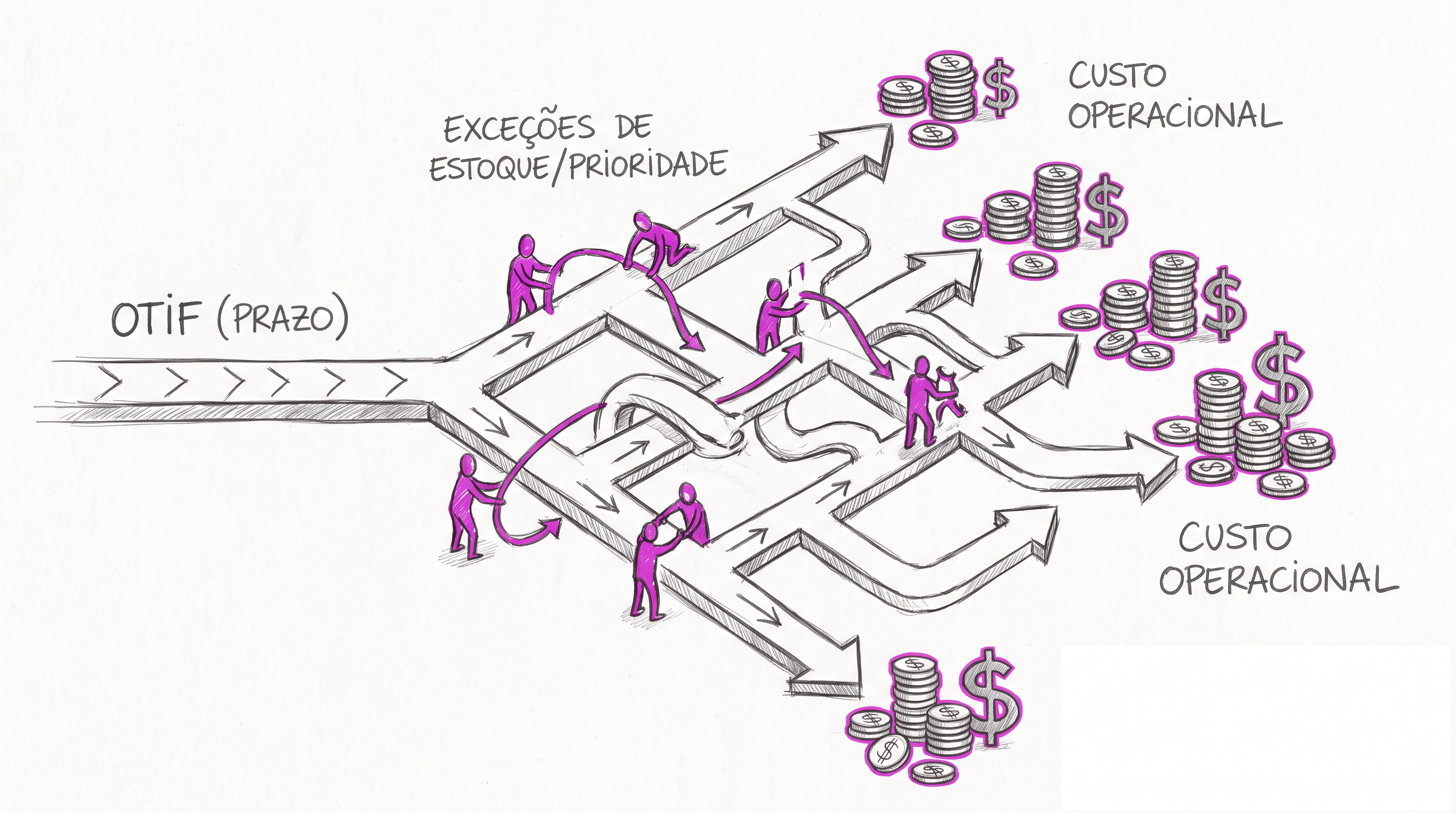
When Every New Order Keeps the Delivery Date but Raises Operating Costs
TL;DR
- A factory capable of continuous adaptation can maintain OTIF while still increasing the unit cost of every order.
- The problem is not adaptation itself, but turning customer-specific commercial terms into operational exceptions involving inventory, lead times, and priorities.
- AI agents can accelerate decisions, but without clear governance criteria, they can also execute exceptions more frequently.
- Before automating, the COO must distinguish profitable flexibility from complexity that merely transfers the cost of negotiation to the factory floor.
How Can You Tell Whether the Factory Is Adapting to Customers or Absorbing Too Many Exceptions?
For a COO, few situations are as ambiguous as an operation that continues to deliver, maintains OTIF, and accommodates customer-specific requirements—while requiring more effort with every new order.
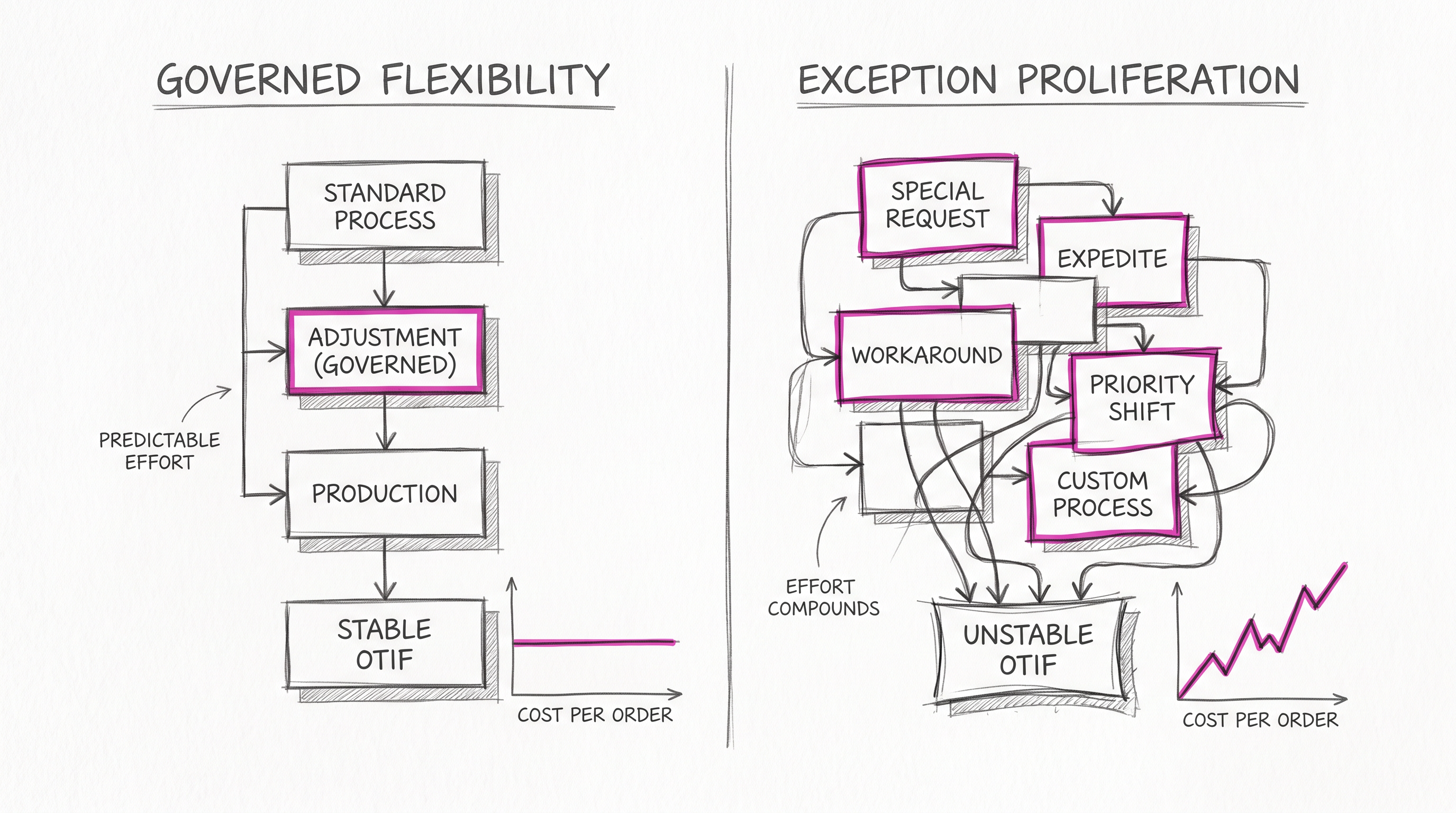
At first glance, the factory appears flexible. Replenishment, production planning, and priorities are continuously adjusted. From a sales perspective, this capability may be seen as a competitive advantage: the company accommodates specific terms without disrupting customer service.
The problem emerges when flexibility stops being a structured capability and begins to depend on a chain of exceptions. Each order brings its own combination of inventory requirements, lead times, or priorities. The factory adapts again, preserves the delivery commitment, and adds yet another customer-specific rule to its routine.
This is the central tension behind the concept of a “living factory,” based on the thesis provided as source material: continuously adjusting replenishment and planning can turn customer-specific commercial terms into operational exceptions. For the COO, the risk is maintaining OTIF while the unit cost per order increases with every new customer.
A service metric alone does not reveal the full picture. It shows that the commitment was met, but not necessarily how many additional decisions, schedule changes, and priority overrides were required to meet it.
As a result, the operation may appear healthy based on the final outcome while accumulating complexity along the way.
The Order Does Not Begin on the Factory Floor
An operational exception is often the consequence of an earlier sales decision. A specific lead time, expedited priority, or special term may appear feasible when considered in isolation. Its full impact, however, only becomes clear when that decision enters production planning and competes with other commitments for capacity and resources.
The COO inherits the effects of a negotiation that may not have been structured to account for all its operational consequences.
In this scenario, the factory must repeatedly answer questions such as:
- Which order should receive priority?
- What inventory adjustment is required?
- Which delivery date can still be maintained?
- Which commitment must be reassessed?
- Is this customer-specific requirement an accepted rule or a one-time exception?
When these answers are not based on shared criteria, the operation decides case by case. The problem is not just the time spent making each decision. Every choice can create a precedent that reappears in future orders.
A new customer does not add only volume. That customer may also add a new way of operating.
The False Sense of Security Created by Maintaining OTIF
Maintaining OTIF matters, but it is not enough to conclude that the operation is scaling efficiently. A company can deliver in full and on time through a series of adjustments that increase the unit cost per order.
This distinction matters to the COO because efficiency is not just about delivering. It is about delivering without forcing the organization to informally redesign how it operates after every negotiation.
There are two very different scenarios:
- The factory adjusts parameters within predefined limits.
- The factory creates a custom response for every customer-specific commercial term.
The first is governed flexibility. The second is exception proliferation.
Both may produce the same apparent outcome for the customer. Internally, however, they create very different trajectories. Governed flexibility is repeatable. An exception requires new analysis, new prioritization, and another adjustment.
When this distinction is not visible, sales growth can amplify complexity that was already present. Each additional customer increases not only demand, but also the number of conditions the operation must interpret.
Where AI Agents Fit
Agentic AI makes it possible to monitor variables and execute adjustments continuously. This aligns with the idea of a factory that responds dynamically to changes in replenishment and production planning.
But execution speed is not a substitute for decision governance.
If an agent’s only objective is to preserve a delivery commitment, it may find ways to prioritize the order without adequately evaluating whether that decision should become a recurring practice. The technology accelerates adaptation, but it can also accelerate the adoption of exceptions.
Before delegating decisions to agents, the company must define what they are authorized to decide, within which limits, and based on which criteria. It must also establish when a situation should be escalated for human review.
The question, then, is not only whether an agent can adjust the production plan. It is whether the company understands its own negotiation DNA: the rules, concessions, limits, and dependencies that turn a commercial term into an operational decision.
Without this structured knowledge, automation tends to reproduce existing ambiguity. With governance, AI can help identify patterns, apply consistent criteria, and reserve human intervention for truly exceptional situations.
The Cost of Inaction
When a company does not distinguish adaptation from exception, the cost appears gradually. The operation does not need to stop. It is enough for each order to require slightly more interpretation and coordination than the one before it.
Inaction can keep three problems hidden:
- OTIF remains intact but no longer represents the full economic efficiency of delivery.
- Customer-specific terms become operational obligations without explicit criteria.
- New customers increase the number of decisions required, not just the volume processed.
The risk is an operation that scales customer service without scaling repeatability. The factory continues to respond, but it depends on increasingly specific adjustments.
Automating this scenario without first reviewing it does not eliminate the problem. It merely shortens the time between creating an exception and executing it.
Principles for Regaining Scale Without Losing Flexibility
- Separate rules from exceptions: Recurring conditions must be recognized and governed as rules rather than treated indefinitely as isolated cases.
- Connect negotiation and operations: Lead times, inventory, and priorities should be considered before a commercial term becomes a customer commitment.
- Govern before automating: AI agents need defined decision boundaries, escalation criteria, and accountability.
- Evaluate orders beyond OTIF: Meeting a commitment does not, by itself, show whether the way it was fulfilled is economically repeatable.
- Preserve negotiation DNA: The criteria used in decisions must remain visible, structured, and reviewable.
- Automate the pattern, not the ambiguity: AI should expand the company’s ability to apply governed decisions—not institutionalize poorly understood exceptions.
This is where transaction cost becomes a relevant architectural metric. Every inquiry, approval, reinterpretation, or adjustment required to turn a negotiation into execution adds effort to the order.
A B2B Commerce Platform for Governed Negotiation can help connect commercial terms with their operational consequences through a governed workflow. In the case of the CWS Platform, the goal is to structure B2B negotiation before customer-specific requirements reach operations as disconnected exceptions. The technology does not replace the COO’s decisions, but it can make the company’s decision criteria executable and auditable.
FAQ
Doesn’t Maintaining OTIF Mean the Operation Is Efficient?
Not necessarily. According to the source thesis, a factory can maintain OTIF while the unit cost per order increases. The metric must be evaluated alongside the number of adjustments required to maintain delivery performance.
Can AI Agents Solve Exception Proliferation?
Only when they operate within clear rules and limits. Without governance, they can accelerate adjustments without distinguishing between planned flexibility and a concession that should not be repeated.
Does Every Customer-Specific Commercial Condition
"The support model is differentiated — the project team actually understands B2B complexity and stays close throughout implementation."
Want to see this in your operation?
Real B2B operations already run on it.