Building materials distribution: OroCommerce or CWS Platform?
The same product in several contexts, each job's price table, and the lifespan of a version: the building materials channel through the Director of Commerce lens.

Editorial note: an architecture comparison between OroCommerce and CWS Platform for building materials distribution, written for the Director of Commerce, who owns the digital channel and the catalog. Every fact about OroCommerce comes from its public documentation, with the address next to it.
In building materials distribution, the same product lives several lives. The same bag of cement shows up for the neighborhood dealer as a replenishment item, for the general contractor as an input to a job site with its own contract, and for the installer as part of a system, next to the mortar and the admixture. Customers search by the context they work in, not by the tree the product record inherited from the ERP.
Pricing follows the same logic: the contractor negotiates per job, the dealer buys from the group price list. And the job site takes delivery in phases, sometimes from more than one distribution center.
This comparison looks at OroCommerce and CWS Platform from that angle only: how the catalog places the same product in several contexts, where each job's price table lives, and how long the installed version is supported. It is not a feature ranking. The license and integration math is in the comparison what goes into the bill when the digital channel grows.
What OroCommerce does well
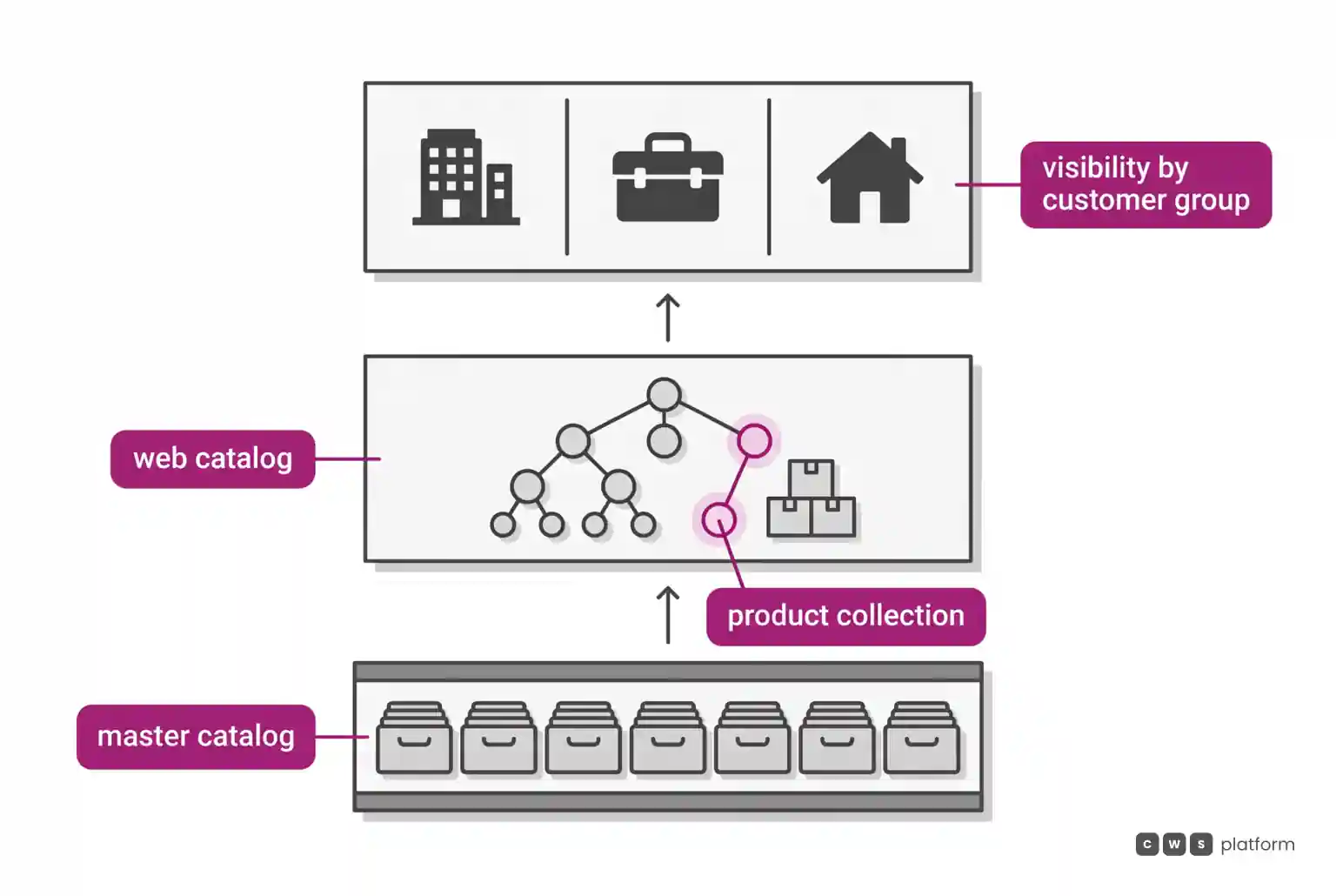
OroCommerce separates the product record from navigation. The master catalog organizes products into categories, with inherited inventory, unit, and purchase-limit settings, and the web catalog builds storefront navigation as a tree of content nodes, with variants that can be category pages, product pages, dynamic product collections, or landing pages. The same URL can carry visibility restrictions by location, website, or customer group.
Search helps buyers who use the name they say on the job site. According to the search guide, the Enterprise edition brings weighting by searchable attribute, typo-tolerant search, global or per-website synonyms, and saved searches that alert on new products and restocks.
On pricing, price lists can be assigned per customer, per customer group, per website, or globally, with quantity tiers. And the customer's address book accepts multiple addresses, each with types such as billing and shipping.
Where the architecture diverges
The divergence that matters to the Director of Commerce sits in two lines of the vendor's documentation, one about the catalog and one about the lifespan of a version:
- limitation recorded in the vendor's documentation, accessed on October 16, 2026: a product can reside in only one category of the master catalog ("It is important to remember that one product can reside only in one category of the master catalog.", https://doc.oroinc.com/user/concept-guides/catalog-promotions/master-catalog/).
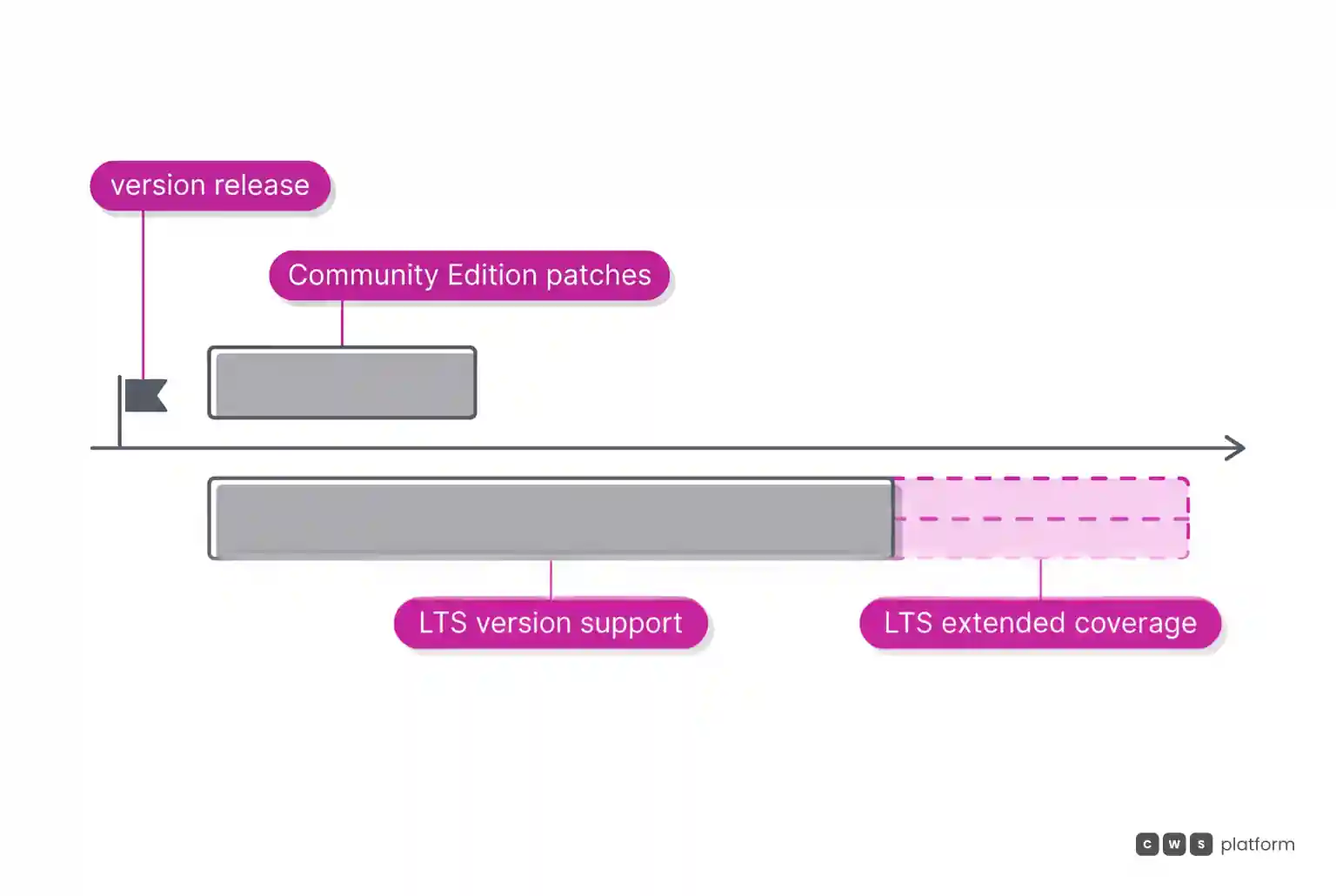
- limitation recorded in the vendor's documentation, accessed on October 16, 2026: extended version coverage may be available for purchase on a case-by-case basis; LTS versions of the Enterprise Edition are supported for 48 months from release; the Community Edition receives patch releases for 12 months after each version's release ("may be available for purchase on a case-by-case basis", "versions of OroCommerce Enterprise Edition are supported for 48 months from the release date.", "The Oro team produces patch releases for each version of OroCommerce Community Edition for 12 months after its release.", https://doc.oroinc.com/community/release-process/).
The first one decides who works the catalog. Because the product lives in a single master catalog category, the other contexts where the cement appears are built in the web catalog, with collections and content nodes. It works, and it is the path the documentation describes for navigation; the practical effect is that each new context, such as a building system or a job-site line, becomes content curation work, maintained in parallel to the product record.
The second one sets the calendar. The Enterprise LTS version is supported for 48 months, with extended coverage that may be available for purchase case by case; the Community Edition receives patches for 12 months. For the Director of Commerce, that becomes a date on the plan: at some point during the contract, the channel has to move to a new version or negotiate an extension.
On CWS Platform, all customers run the same version of the platform. Commercial policy sits in parameters of the Commerce Rules Engine (CDL Workspace): price tables, rules, and contracts are configurable on the platform and can come from the ERP or the CRM through an API, with customizable decimal places. Net terms work with split shipments, scheduled deliveries, multiple ship-to addresses, and multiple ship-from locations.
| decision | OroCommerce, per the documented mechanism | CWS Platform |
|---|---|---|
| Where each customer's or job's price table lives | Price lists per customer, group, website, or global, with quantity tiers | Price tables, rules, and contracts configured on the platform or received from the ERP and the CRM through an API, with customizable decimal places |
| How long a version is supported | Enterprise LTS for 48 months, with an extension that may be available for purchase case by case; Community Edition patches for 12 months | All customers on the same version |
| How the job site takes delivery | Multiple addresses in the customer record | Net terms with split shipments, scheduled deliveries, multiple ship-to addresses, and multiple ship-from locations |
The commerce decision is knowing where the work of maintaining the channel sits: how many catalog contexts depend on curation, where each job's contract lives, and on what date the version has to change.
What changes in building materials distribution
For whoever owns the channel, the difference shows up on three fronts.
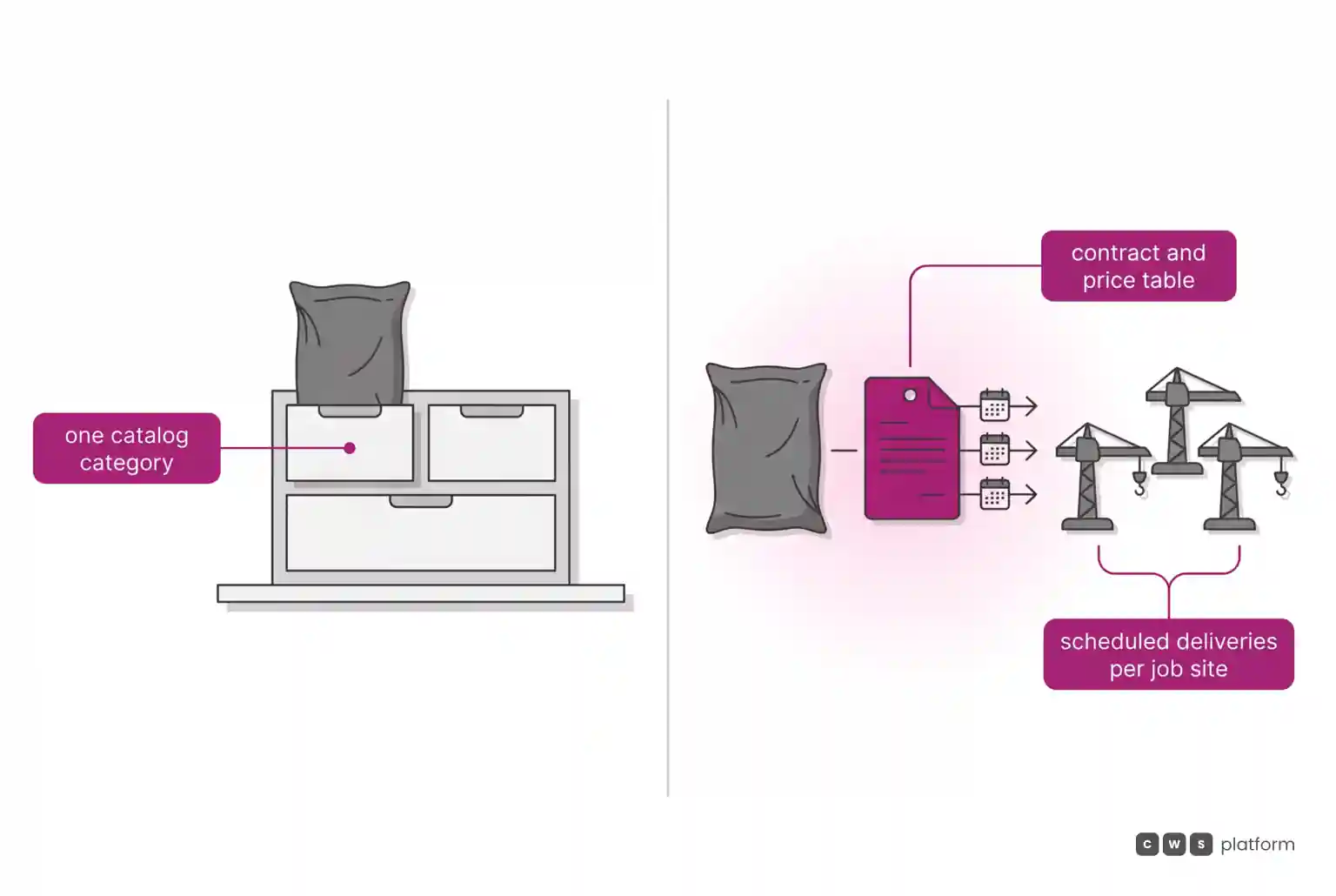
The first is the catalog. In building materials, the same item serves different audiences, and each audience expects to find it in its own context. It is worth measuring how many contexts your catalog really has and who will maintain them: every node that depends on manual curation is a cost that grows with the assortment.
The second is the job price. The contractor buys under contract, and the contract usually originates in the ERP or the CRM. On CWS, price tables, rules, and contracts are configurable on the platform or arrive from the ERP and the CRM through an API, and the customer's credit limit is maintained on the platform. The cart holds 250 line items by default, configurable, which fits the materials list for a phase of a job. And thousands of promotions can run at the same time, from end-of-line closeouts to a tile brand's campaign.
The third is delivery. Job sites take delivery in phases. On CWS, a net-terms order accepts split and scheduled shipments, to multiple ship-to addresses and from multiple ship-from locations, and the sales rep can build the cart with the items and the ship-from location of each one and send the link for the customer to close. The order records who built the cart and who chose the payment.
Three questions help bring this point into the evaluation of any vendor: how many contexts the same product needs in the storefront, and who maintains each one; where each job's contract originates, and how it reaches the order; and on what date in the contract the installed version stops being supported.
When to choose OroCommerce
OroCommerce fits scenarios with these characteristics:
A content team dedicated to navigation. Choose this architecture when the company has a team to build and maintain context-based navigation in the web catalog, with collections, landing pages, and visibility by customer group.
Search as the customer's main entry point. Choose this architecture when buyers arrive by product name, with variations and typos, and the company wants synonyms and restock alerts, as the Enterprise edition's search guide describes.
A release cycle planned with room to spare. Choose this architecture when the company works with long migration windows and wants the Enterprise LTS version, supported for 48 months, according to the release process.
When CWS Platform is the right choice in this scenario
CWS Platform is the right choice when the channel needs to treat job contracts, phased delivery, and versioning as part of the platform, not as parallel projects.
Contract and price table as parameters. Choose this architecture when each contractor negotiates its own terms. Price tables, rules, and contracts live in the Commerce Rules Engine (CDL Workspace), on the principle of configuration over code, or arrive from the ERP and the CRM through an API.
Delivery by job phase. Choose this architecture when the same order needs to ship in parts, on different dates, from several distribution centers. Net terms work with split shipments, scheduled deliveries, multiple ship-to addresses, and multiple ship-from locations.
A materials list in the cart. Choose this architecture when the typical order is long. The cart holds 250 line items by default, configurable, and the sales rep can build it and send the link for the customer to close.
One version for every customer. Choose this architecture when the channel wants to always run on the current version of the platform. All customers run the same version.
Where to go from here
If the question is still which platform model fits your operation, before any vendor, the starting point is the three B2B commerce platform models.
If the decision depends on how your catalog and your job contracts are organized today, it is worth talking to a CWS Platform specialist and mapping, with your own assortment and job sites, where each rule will live. The page When the Catalog Becomes Chaos covers the pain behind this scenario in depth, without talking about any vendor.
"responsive, technically engaged, and willing to work through complex commercial rules (negotiated pricing, credit, customer-specific conditions) rather than pushing generic answers"
Want to see this in your operation?
Real B2B operations already run on it.