← The Cost of Selling Transformation Blockers
When Integration Breaks Everything

B2B portal for sales operations: commercetools or CWS Platform?
A B2B sales portal comparison for the CIO/CTO: commercetools Connect delivers events at least once with no ordering guarantees and requires code in a GitHub repository with a release tag. CWS Platform is API-first, with REST, webhooks, and commercial policy in parameters.
Read →
B2B self-service portal for multiple branches: Optimizely or CWS Platform?
The multi-branch customer is the hardest test of self-service. We compare Optimizely Configured Commerce and CWS Platform on where the financial information a branch sees lives and how operations pulls volume from the portal.
Read →
Optimizely Configured Commerce vs. CWS Platform: who maintains the ERP integration?
For a CIO, the cost of ERP integration lies in who keeps the connector alive as the framework, the ERP, and the platform change. We compare Optimizely Configured Commerce and CWS Platform from that angle.
Read →
OroCommerce vs. CWS Platform: what happens to order operations after checkout?
Architecture comparison for the COO: in OroCommerce, the full OroCloud backup does not cover Elasticsearch and RabbitMQ and external order import does not export legacy history; on CWS Platform, the order talks through APIs and accepts split shipments from multiple origins.
Read →
Spryker or CWS Platform: Where Does Customer Pricing Travel in the ERP Integration?
For technology leaders at distributors: what the Spryker documentation records about the Data Exchange API and Glue, and where CWS Platform keeps commercial rules.
Read →
The Three B2B Commerce Platform Models: Assemble, Buy Ready-Made, or Move Commercial Rules Into the Platform
A category guide for anyone evaluating B2B commerce platforms: three models, where each keeps commercial rules, and who pays to maintain them.
Read →
commercetools or CWS Platform: What Does It Cost to Keep Commercial Rules Integrated?
For technology leaders at distributors: what the commercetools documentation records about API limits, and where CWS Platform keeps commercial rules.
Read →
ICMS, ST, and NF-e: Where Brazilian Tax Lives in B2B E-commerce
Where will ICMS, tax substitution, and NF-e live in your B2B e-commerce? What the public documentation of SAP, Salesforce, and Adobe records about tax.
Read →
B2B Systems Integration: What to Connect First and How
B2B systems integration breaks when treated as simple data piping instead of source-of-truth governance. Here is how to prioritize your rollout.
Read →
Integration Maintenance Costs: SAP Commerce Cloud vs CWS Platform in API Architecture
Analyze the real technical maintenance costs between SAP Commerce Cloud and CWS Platform through decoupling, pipelines, and data governance.
Read →
What an ERP Is, What It Does, and What It Doesn't Solve in B2B Sales
While ERPs excel at back-office accounting, inventory, and order fulfillment, forcing them into front-end B2B trade execution breaks the customer experience.
Read →
Essential B2B E-Commerce Integrations: ERP, Tax, Payments, Shipping, and CRM
Integration checklists are misleading without clear sync frequency, direction, and effort. Discover the essential connections needed to run complex B2B commerce.
Read →
ERP Sales Module vs. Dedicated B2B Commerce Platform
Forcing core ERP interfaces onto B2B buyers and sales reps creates costly friction. Learn when your ERP suffices and when to separate commerce.
Read →
What Needs to Flow Between ERP and B2B Commerce, and at What Cadence
B2B buyer portals fail when integration treats all data equally. Here is how to establish data ownership and real-time synchronization cadences.
Read →
How to Modernize B2B Sales Without Migrating Your ERP
Discover how wholesale distributors can modernize B2B sales operations without the multi-million-dollar risk of replacing legacy ERPs.
Read →
Real-Time B2B Inventory: Webhooks, APIs, or Batch
Out-of-stock orders erode buyer trust and drive customers back to phone calls. Learn how to combine webhooks, APIs, and batch sync to maintain accurate multi-warehouse inventory without choking your ERP.
Read →
Where ERP Marketplace Integration Breaks Down
Discover why ERP marketplace integration bottlenecks digital expansion and how to decouple core accounting from high-frequency transactions.
Read →
Adobe Commerce vs. CWS Platform: Where Should Replenishment Policies Run in a B2B Procurement Marketplace?
For recurring contract purchases, the storefront is not the core decision. The key question is where commercial policies run and how each order reaches fulfillment in a consistent state.
Read →
Seven Questions That Separate B2B Commerce Architectures
Your RFP scorecard doesn't separate vendors because every platform answers 'yes' to the same questions. These seven questions surface the difference that would otherwise show up eighteen months in: whether commercial logic lives inside the platform or outside it.
Read →
Is Your Partner Integration Moving Fast Before It’s Ready to Scale?
Going live does not mean a partner integration is ready to be replicated. Early governance and technical support make speed more sustainable.
Read →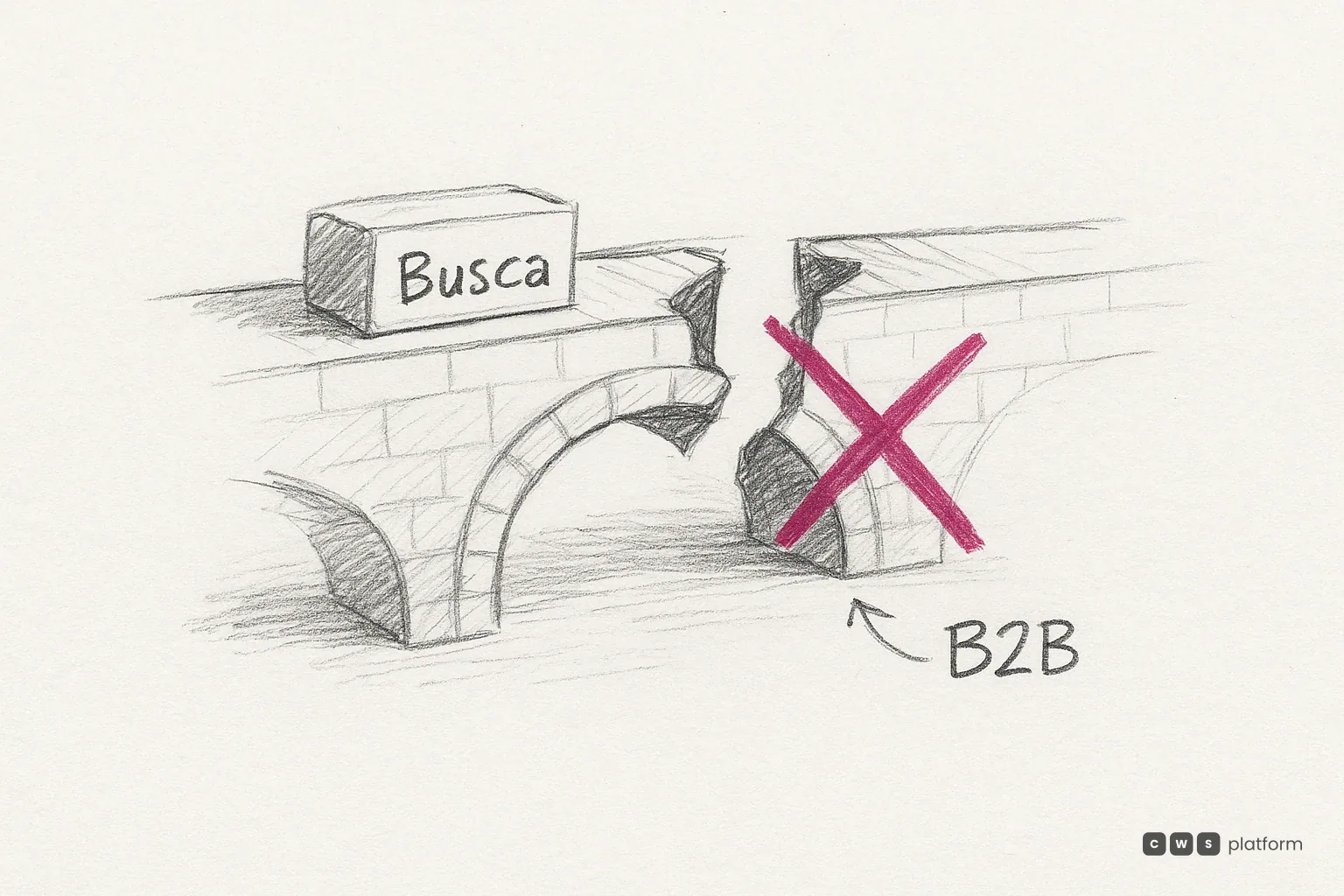
When B2B Search Works Technically but Fails the Business Case
A search engine integration does not guarantee an economically viable B2B operation. Product catalogs, pricing, credit, account permissions, and exceptions must also shape the decision.
Read →
When Every Business Unit Decides Differently, ERP Becomes a System of Record, Not Control
Local ERP systems can keep executing orders while a central orchestration layer determines which commercial terms apply to each customer and context.
Read →
Your ERP Is Full of Data and Empty of Decision
ERP records what already happened; governance determines what can happen next. Without that layer, decisions don't disappear — they migrate to the sales rep's head, the untracked Slack message, and the exception that becomes standard practice.
Read →
Your sales team runs AI, but the data it needs is still inside the rep's head
Auto parts distributors are deploying AI to accelerate quoting and customer service, but hitting a problem that predates the technology: fragmented pipeline data, unwritten pricing policies, and exception rules that live only in a senior rep's memory.
Read →
Your ERP Isn't the Problem. What Governs Everything on Top of It Is.
Replacing SAP or Oracle takes years and doesn't fix the core issue: the absence of a layer that governs pricing, credit, and approvals before an order ever reaches the system of record.
Read →
When You Run on Several ERPs, Which One Is Right?
In an operation with several ERPs and brands, integration isn't wiring one system to another — it's deciding which is right when they disagree on price, stock, and credit. Why integration breaks before the technology enters the picture.
Read →