commercetools vs. CWS Platform: what goes into the three-year total cost of ownership?
Add-ons priced separately and beta features without a service level agreement, from the seat of whoever owns the budget.

Editorial note: an architecture comparison between commercetools and CWS Platform, written for those who answer as CFO. Every fact about commercetools comes from its public documentation, with the address next to it.
A B2B commerce platform proposal reaches finance as a license line and an implementation schedule. The three-year total cost of ownership rarely fits in that line. It builds up over time: a module the team finds out it needs in the second quarter, a feature that goes into production before the vendor takes it out of its testing stage, a renegotiation that happens once the scope is already in use and there is little room to push back.
For whoever owns the budget, the useful question is not what the license costs in year one. It is how many lines the bill will have in year three, and which of them the contract signed today does not describe.
This comparison looks at commercetools and CWS Platform from that angle only: what the license covers, what sits outside it, and what happens to risk when operations come to depend on a feature the vendor still classifies as beta. It is not a feature ranking. If you want the map of platform models first, the post on the three B2B commerce platform models is the place to start.
What commercetools does well
commercetools has a clear answer to a common CFO concern: a license that grows with the revenue of the channel. The pricing page describes the B2B Commerce package with pricing based on order volume rather than GMV, with no explicit cap on the number of channels, catalogs, and storefronts stated in the license.
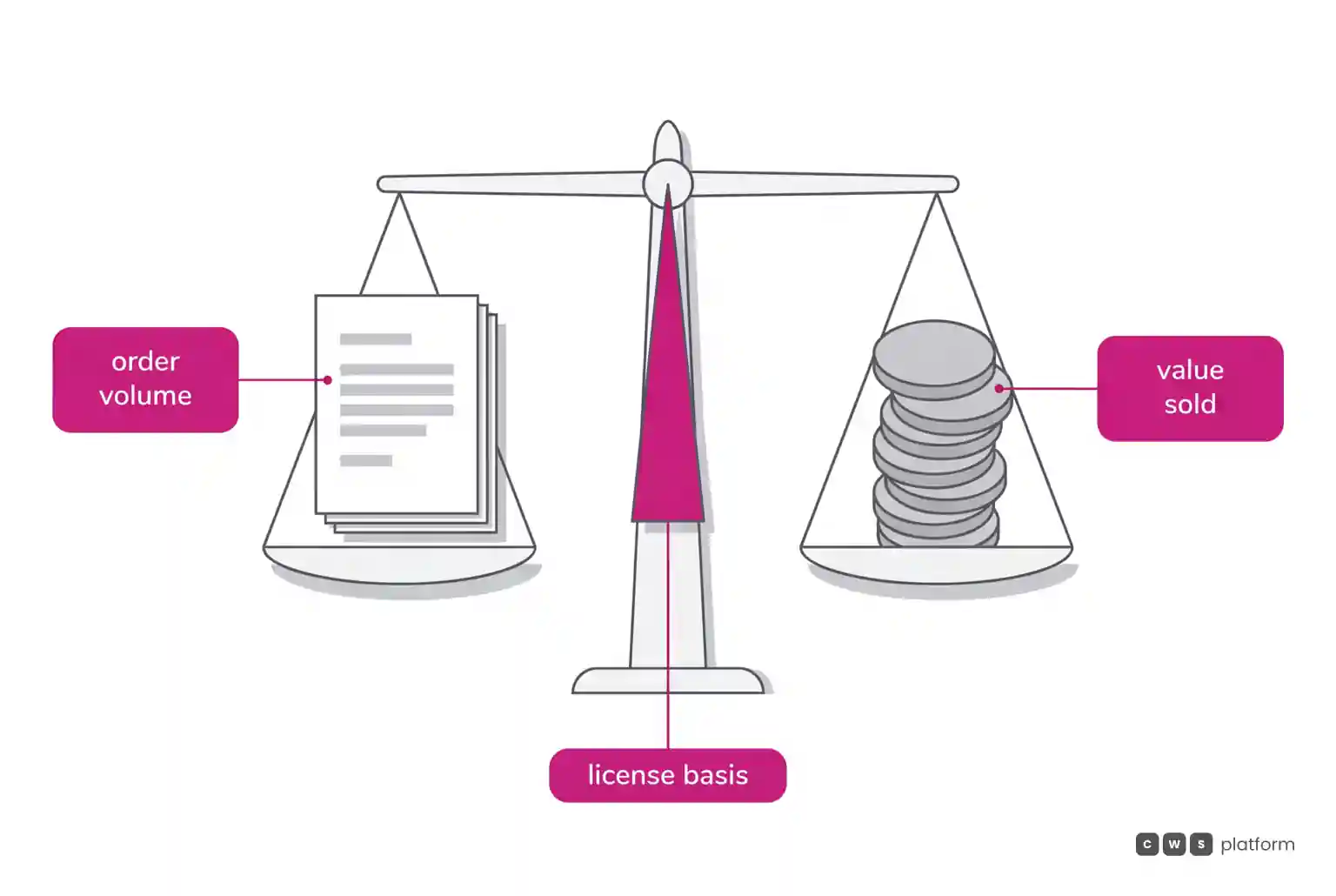
According to the B2B offering documentation, the package includes the Merchant Center interfaces and access through the REST API and GraphQL, plus the B2B baseline: account hierarchies with Business Units, associate roles, buyer approval flows, quotes, and prices isolated through Standalone Prices and per Business Unit, with volume tiers and discount rules.
The documentation also states the stage of each feature. The storefront search overview, for example, says search indexes up to 50 attributes per variant and up to 50 at the product level, and marks the latter as beta. For anyone auditing a contract, that transparency is an advantage: the information exists and can go into the model.
Where the architecture diverges
The divergence that matters to a CFO is what sits outside the license line and what happens to the service level of each feature. The vendor's own documentation records both points:
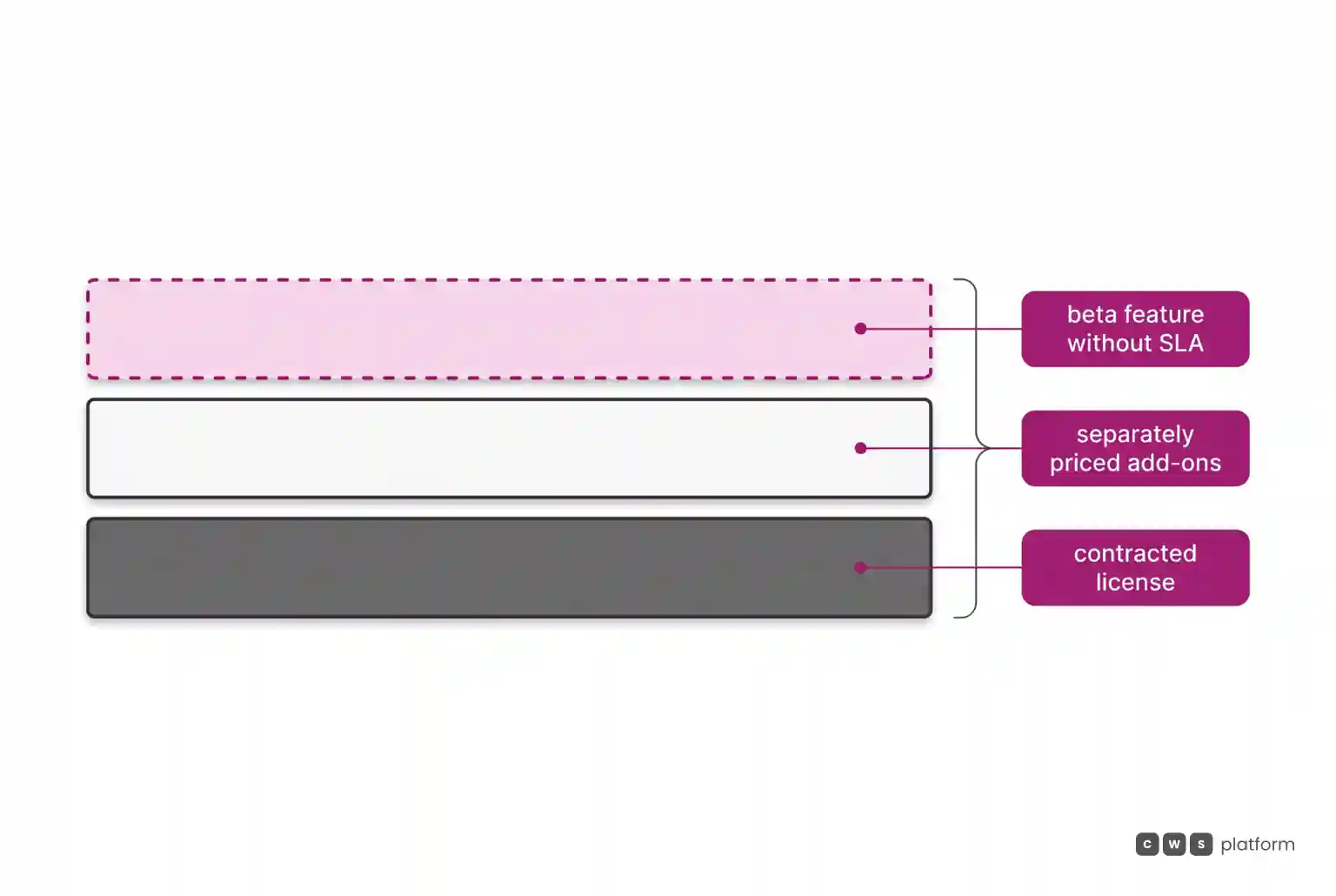
- limitation recorded in the vendor's documentation, accessed on October 16, 2026: add-ons are subject to additional terms and pricing ("Add-Ons are subject to additional terms and pricing.", https://docs.commercetools.com/offering/add-ons)
- limitation recorded in the vendor's documentation, accessed on October 16, 2026: public beta features receive customer support and bug fixes but are not covered by service level agreements or remedies ("They receive Customer Support and bug fixes like general availability features but are not covered by Service Level Agreements or remedies.", https://docs.commercetools.com/offering/compatibility)
Neither record describes a defect. They describe the shape of the contract. Per the B2B offering documentation, HIPAA support and high-performance load testing come in additional Add-On packages, and Intake, which turns free text and files into a cart or a quote request, is itself an Add-On. Each of these items is a line that appears after signature, with its own terms.
The second record affects risk, not price. Product-level attribute indexing, mentioned above, is an example of a feature at that stage. If operations adopt a feature at that stage, it gets support and fixes, but its failure does not trigger the service level agreement. In a three-year model, that is exposure the contract does not compensate.
On CWS Platform, billing is a platform license plus an integration license, with no percentage of sales or GMV. All customers run the same version of the platform, and commercial policy sits in parameters of the Commerce Rules Engine (CDL Workspace).
| decision | commercetools, per the documented mechanism | CWS Platform |
|---|---|---|
| What the license is based on | B2B Commerce package priced by order volume, not GMV | Platform license plus integration license, with no percentage of sales or GMV |
| What comes in after signature | Add-ons with additional terms and pricing, such as HIPAA, load testing, and Intake | Platform license plus integration license, with no percentage of sales or GMV |
| How versions are handled | Public beta features get support and fixes, without service level agreement coverage | All customers run the same version of the platform |
The financial decision is how many lines the software budget will carry in year three, and how many of them the contract describes in year one.
What changes in operations, through the CFO lens
The transaction cost of selling is not only freight and credit. It also includes the cost of keeping the platform that processes the order, and that share is what usually slips out of the initial proposal. Every add-on contracted later is a new negotiation, held when operations already depend on the feature. Every beta feature adopted in production is operational risk that stays with the company rather than with the contract.
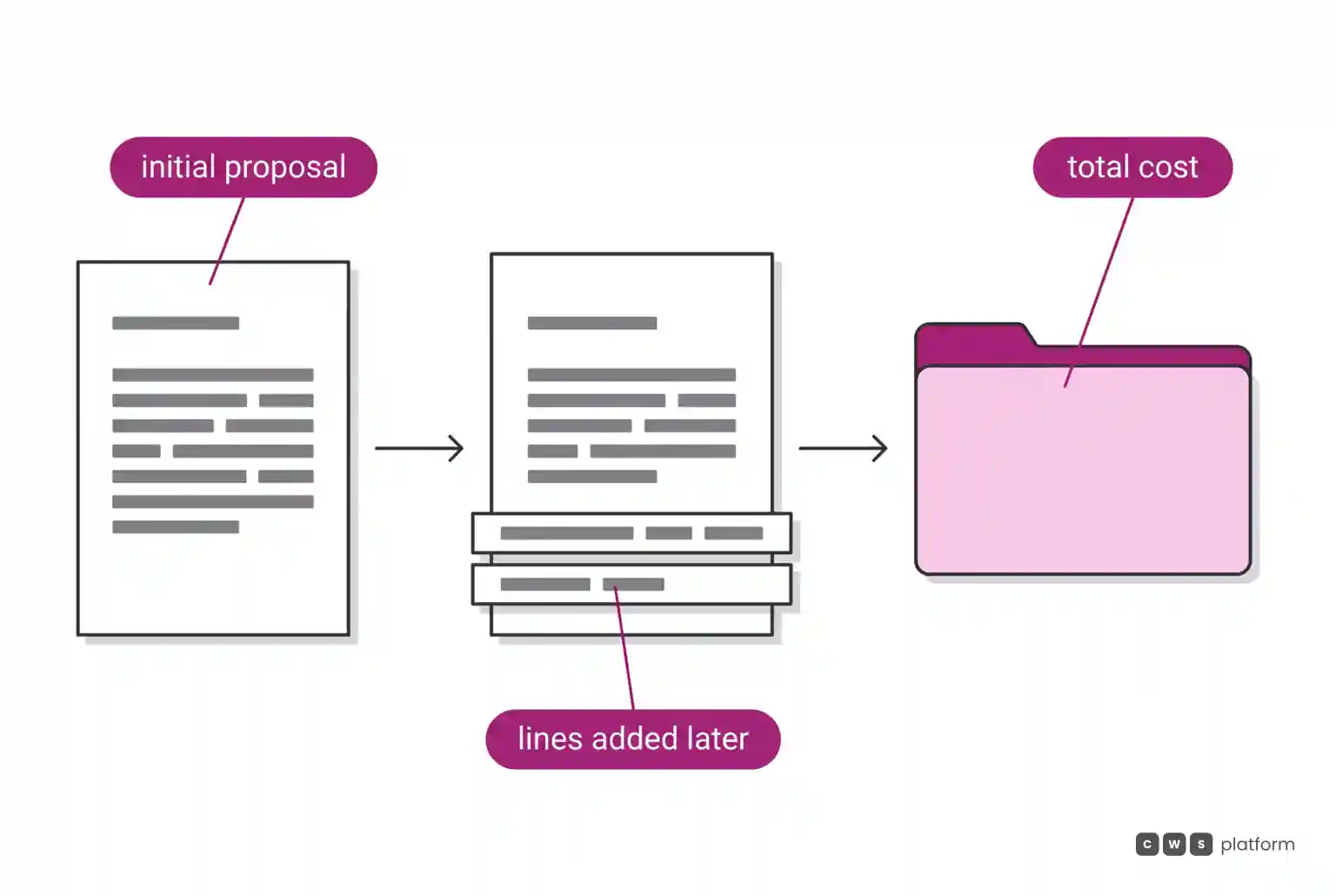
Three questions help bring this point into a negotiation with any vendor. First: which capabilities in the desired scope are add-ons, and what are the terms of each in years two and three. Second: which features the team plans to use are in beta today, and what happens to the service level agreement until they reach general availability. Third: who pays for the rework when the vendor changes the version of a component the company has already integrated.
The third question weighs more than it seems. When each customer runs its own version, upgrades tend to become projects, with estimates, testing, and budget approval. It is worth asking every vendor how it handles versions. On CWS Platform, all customers run the same version.
On CWS Platform, the rules that drive the cost of each order sit in parameters. Price tables, rules, and contracts are configured on the platform and can come from the ERP or CRM through an API, with customizable decimal places. Tax comes from the ERP or from the tax engine the customer already uses. Net terms work with split shipments, scheduled deliveries, multiple ship-to addresses, and multiple ship-from locations.
When to choose commercetools
commercetools fits scenarios where the license model and a composed architecture are explicit goals:
Order-based licensing instead of GMV. Choose this architecture when the main budget concern is a license that does not track the value sold, and the order-volume pricing on the pricing page fits the order profile of the business.
A team that buys capability by capability. Choose this architecture when the company prefers to start lean and add capabilities as needed, accepting that each add-on carries its own terms and pricing, as recorded above.
Governance that tracks each feature's stage. Choose this architecture when the technical and legal teams have a routine for tracking the stage of each feature, as the documentation does in the storefront search overview, and for putting features into production only after general availability.
When CWS Platform is the right choice in this scenario
CWS Platform is the right choice when the three-year budget needs a license with no percentage of what you sell and a single version for all customers.
A license with no percentage of what you sell. Choose this architecture when the company does not want a license calculated on the value sold. Billing is a platform license plus an integration license, with no percentage of sales or GMV.
One version for all customers. Choose this architecture when the company wants to always run the current version of the platform, without maintaining a version of its own. All customers run the same version.
Commercial policy through configuration. Choose this architecture when pricing, promotions, and credit change often. Tables, rules, and contracts are configured on the platform, on the principle of configuration over code; thousands of promotions can run at the same time, the sales rep's discount goes through multi-level approvals, and the customer's credit is maintained on the platform.
A larger book of business with the same team. Choose this architecture when the growth plan does not call for hiring sales reps at the same rate. One sales rep serves thousands of customers, and customer and sales rep use the same interface.
Where to go from here
If you want to see how the same vendor compares from the technology leader's side, the comparison commercetools or CWS Platform: what does it cost to keep commercial rules integrated? covers ERP and CRM integration. If your question is still which architecture fits your operation, the path is the seven questions that separate B2B commerce architectures.
If the decision depends on projecting total cost with your own numbers, it is worth talking to a CWS Platform specialist to build the three-year model line by line. The pages When Selling More Doesn't Mean Earning More and When Integration Breaks Everything cover the pain behind this scenario in depth, without talking about any vendor.
Brands mentioned in this article

Trademarks and logos belong to their respective owners. Mention does not imply partnership or endorsement.
"responsive, technically engaged, and willing to work through complex commercial rules (negotiated pricing, credit, customer-specific conditions) rather than pushing generic answers"
Want to see this in your operation?
Real B2B operations already run on it.