OroCommerce vs. CWS Platform: how does sales rep quoting work?
How many negotiation paths the platform accepts at the same time, and who builds the customer's order when the conversation becomes a transaction.

Editorial note: an architecture comparison between OroCommerce and CWS Platform, written for those who answer as VP of Sales. Every fact about OroCommerce comes from its public documentation, with the address next to it.
At a distributor with a large book of business, a single week holds three very different sales conversations. The key account manager negotiates a quote with a target price and a ship-by date. The territory rep replenishes the customer's usual mix, line by line, with no negotiation at all. And the projects team builds a kit order, with components that only make sense together.
For whoever owns revenue, the platform question is not whether it supports quoting. Almost all of them do. The question is how many negotiation paths it accepts at the same time, and who builds the customer's order when the conversation leaves the inbox and has to become a transaction.
This comparison looks at OroCommerce and CWS Platform from that angle only: the path from quote to order, what happens when teams negotiate in different ways, and where the record of who did what lives. It is not a feature ranking. For the license and integration math, the earlier comparison, what goes into the bill when the digital channel grows, covers the topic through the CFO lens.
What OroCommerce does well
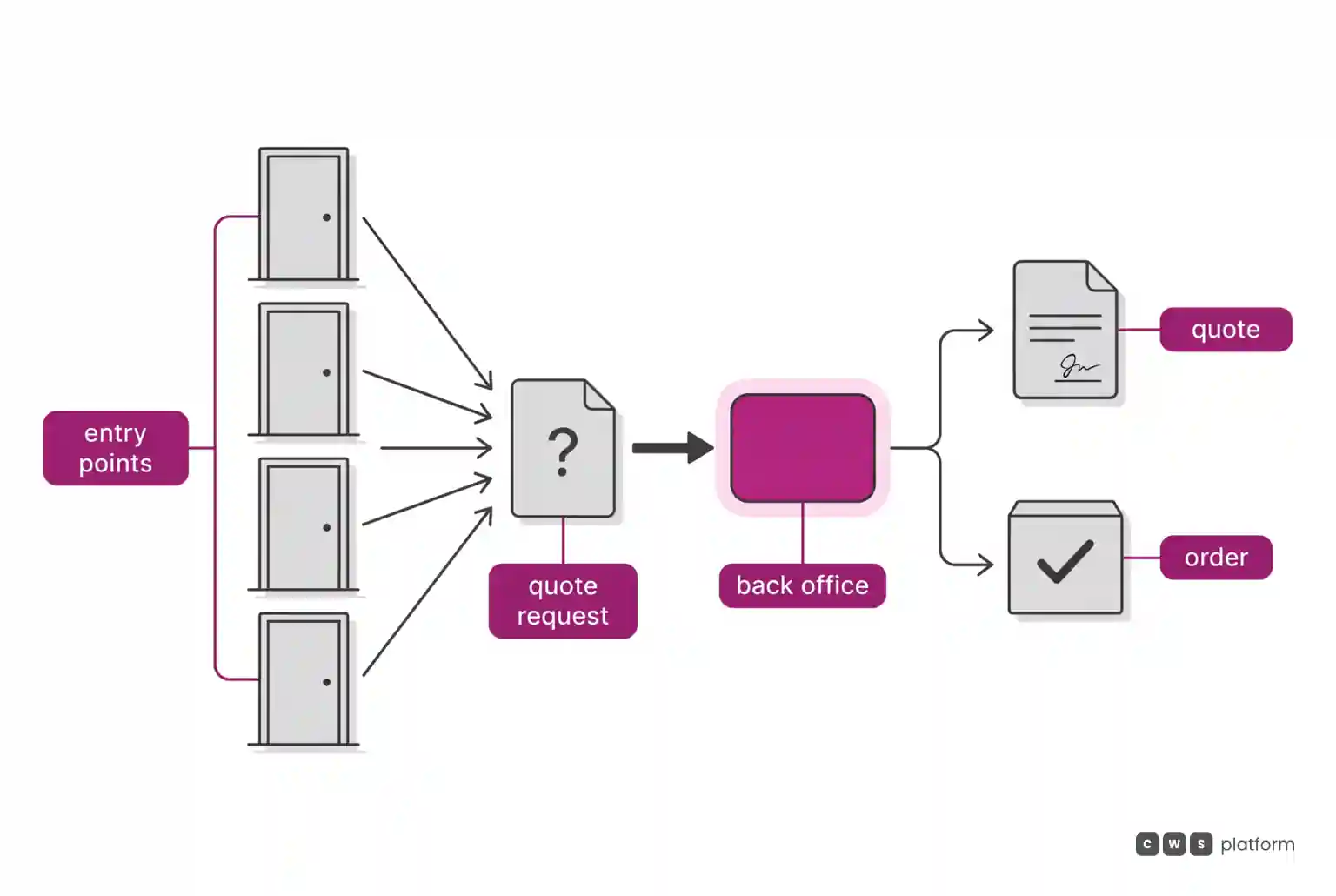
OroCommerce treats quoting as a workflow of its own, with several entry points. According to the RFQ and Quotes guide, the buyer requests a quote from the product page, the account menu, the shopping list, or the quick order form. The back office receives the request and can convert it into a quote, convert it straight into an order, decline it, or delete it. Two default workflows organize the conversation: one for management in the back office and one for the buyer to follow status and responses in the storefront.
On its integrated CPQ and RFQ page, the vendor describes dynamic pricing rules, customer-specific catalogs, and approval workflows routed by region, brand, opportunity value, or segment. For a sales organization built around territories, that routing matches how approval authority already works.
Sales reps also have a way to act on the customer's behalf. The Login as Customer User feature lets a back-office user enter the storefront as a specific buyer; it belongs to the Enterprise edition, is disabled by default, and requires the matching capability in the operator's role. And the Field Sales App serves field reps, saving orders as drafts while offline and syncing them when the connection comes back.
Where the architecture diverges
The divergence that matters to the sales organization sits in two design rules, recorded in the vendor's own documentation:
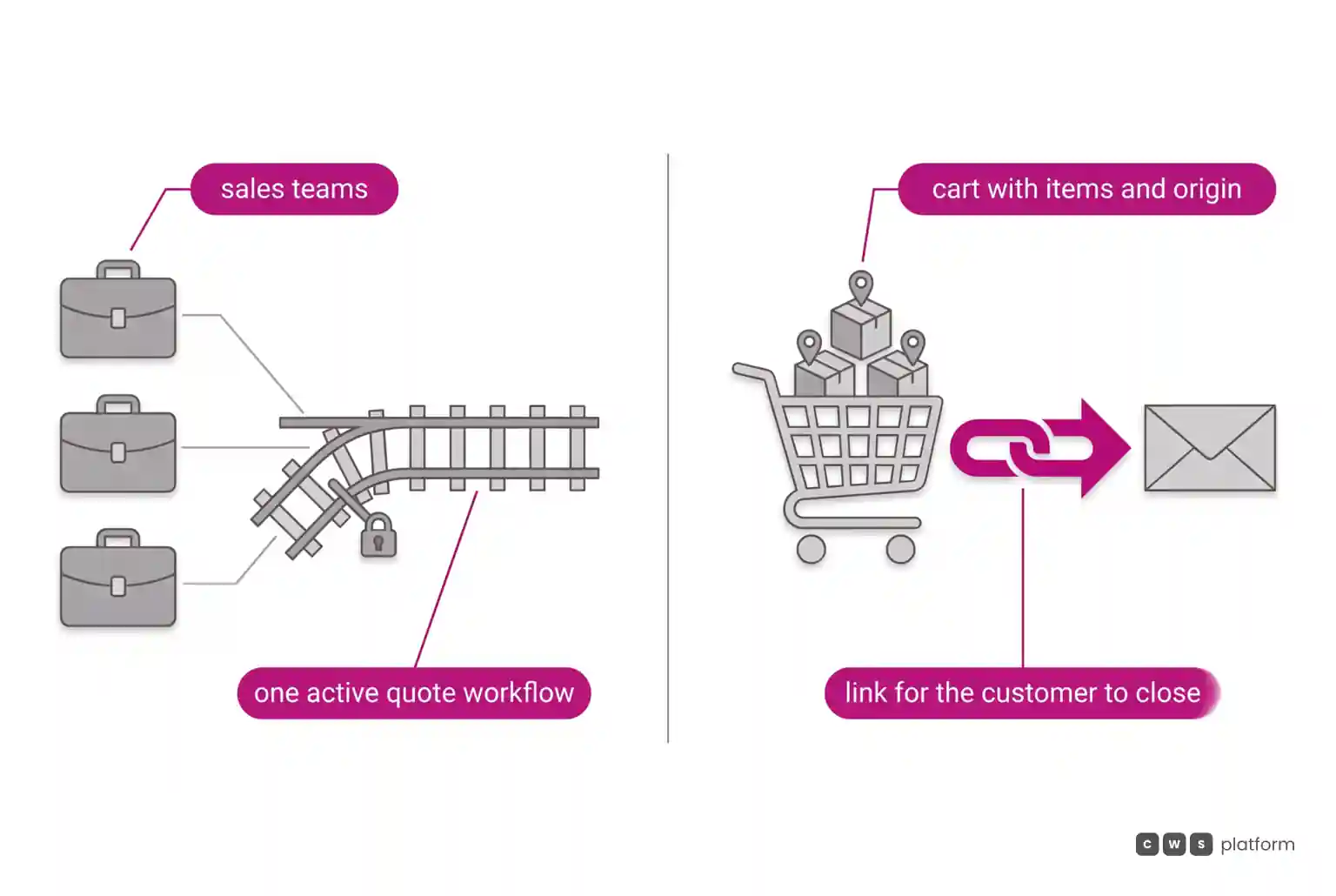
- limitation recorded in the vendor's documentation, accessed on October 16, 2026: quote workflows are mutually exclusive and only one can be activated for the application ("the Quote-related workflows are mutually exclusive, meaning that only one workflow can be activated for your application.", https://doc.oroinc.com/user/concept-guides/customers-sales/rfq-quotes/).
- limitation recorded in the vendor's documentation, accessed on October 16, 2026: product kits require configuration that the quick order form does not support ("as product kits require configuration that the quick order form does not support.", https://doc.oroinc.com/user/storefront/quick-order-form/).
The first one sets the shape of negotiation for the entire application. If the key account team needs a multi-step quote workflow and the replenishment team needs a shorter one, both share whichever workflow is active, and the difference between them has to be handled outside that workflow. The second one separates the kit order from the fastest reorder path: a customer who replenishes through the quick order form builds the kit some other way.
Neither one stops a sale. They decide where each team's negotiation takes place.
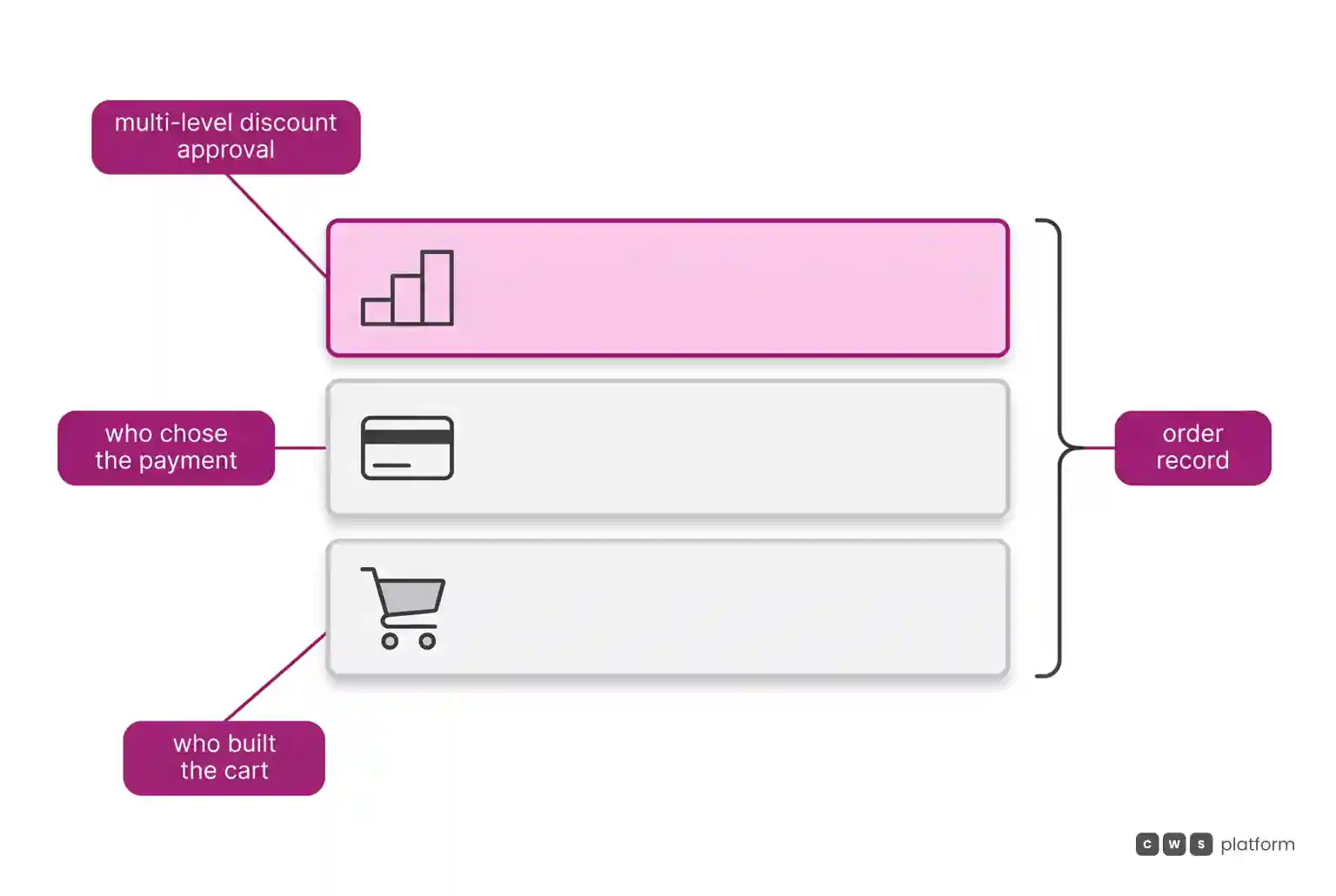
On CWS Platform, negotiation starts from the cart. The sales rep builds a cart with the items and the ship-from location of each one and sends the link for the customer to close. Customer and sales rep use the same interface, and the order records who built the cart and who chose the payment. The rep's discount goes through multi-level approvals, and price tables, rules, and contracts are configured on the platform, in the Commerce Rules Engine (CDL Workspace), or arrive from the ERP and the CRM through an API.
| decision | OroCommerce, per the documented mechanism | CWS Platform |
|---|---|---|
| Where negotiation starts | The buyer's quote request (product page, account, shopping list, or quick order form), converted into a quote or an order in the back office | A cart built by the sales rep, with the items and the ship-from location of each, sent as a link for the customer to close |
| How many quote workflows are active | One quote workflow per application | Commercial policy as parameters in the Commerce Rules Engine (CDL Workspace), with multi-level discount approvals |
| How fast reordering works | Quick order form, with product kits outside it | A cart in the same interface for customer and sales rep, with 250 line items by default, configurable |
| What the order records about who acted | Owner and status of the quote request | Who built the cart and who chose the payment |
The sales decision is choosing where negotiation lives: in a single quote workflow shared by every team, or in the order itself, built by whoever is serving the customer.
What changes in operations, through the VP of Sales lens
For sales leadership, the difference shows up in three places in day-to-day work.
The first is coverage of the book of business. When every negotiation goes through a formal quote request, reps spend time administering quotes the customer could have closed alone with the right price on screen. On CWS, one sales rep serves thousands of customers, and the same interface serves the customer buying alone and the rep who steps in to help. Going digital does not eliminate the sales rep: the rep covers the points where the customer gets stuck.
The second is the negotiation itself. Discount and payment terms are convertible currencies in a real conversation, and a rep who can only move one of them will push it to the limit. On CWS, net terms work with split shipments, scheduled deliveries, multiple ship-to addresses, and multiple ship-from locations, and the same order accepts more than one payment method, with rules combined in the CDL Workspace. The customer's credit limit is maintained on the platform, which gives the rep payment terms as a lever inside a known rule.
The third is governance. When the order records who built the cart and who chose the payment, leadership can separate assisted sales from self-service without a side spreadsheet. And when discount approval has levels, an exception becomes a recorded approval, not a hallway conversation.
Three questions help bring this point into any evaluation: how many negotiation formats the sales organization uses today, and whether the platform accepts all of them at the same time; who builds the order when the customer asks for help, and where that is recorded; and how the kit, the replenishment mix, and the negotiated quote coexist in the same channel.
When to choose OroCommerce
OroCommerce fits scenarios with these characteristics:
Negotiation concentrated in a single quote workflow. Choose this architecture when the company negotiates one way, with a quote request that becomes a quote and then an order, and wants that workflow ready to use, as the RFQ and Quotes guide describes.
Approvals routed by territory or brand. Choose this architecture when sales approval authority follows region, brand, opportunity value, or segment, as the vendor presents on its integrated CPQ and RFQ page.
Reps who sell without connectivity. Choose this architecture when the field team needs to capture orders offline, as the Field Sales App allows.
When CWS Platform is the right choice in this scenario
CWS Platform is the right choice when the sales organization negotiates in more than one way and wants the order, not a separate workflow, to be where negotiation happens.
The rep builds, the customer closes. Choose this architecture when the sales rep needs to prepare the order and leave the decision to the customer. The rep builds the cart with the items and the ship-from location of each one and sends the link; customer and rep use the same interface.
Commercial rules as parameters. Choose this architecture when tables, rules, and contracts change often. They live in the Commerce Rules Engine (CDL Workspace), on the principle of configuration over code, or arrive from the ERP and the CRM through an API, and discounts go through multi-level approvals.
Terms and payment as part of the negotiation. Choose this architecture when closing depends on payment terms, split shipments, or more than one payment method on the same order.
A large book of business with a lean sales team. Choose this architecture when the goal is to cover the entire book without growing headcount. One sales rep serves thousands of customers, and the order shows who built the cart and who chose the payment.
Where to go from here
If the question is still which platform model fits your operation, before any vendor, the starting point is the three B2B commerce platform models.
If the decision depends on how your teams negotiate today, it is worth talking to a CWS Platform specialist and mapping, with your own cases, where each negotiation takes place: quote, replenishment, and kit. The page When Channels Fight Each Other covers the pain behind this scenario in depth, without talking about any vendor.
"responsive, technically engaged, and willing to work through complex commercial rules (negotiated pricing, credit, customer-specific conditions) rather than pushing generic answers"
Want to see this in your operation?
Real B2B operations already run on it.