CWS Platform Perspective

B2B marketplace: Spryker or CWS Platform?
A B2B marketplace comparison for the VP of Sales: how Spryker creates the merchant relation between merchant and buyer, what the documentation says about buy-box and the Merchant Portal, next to CWS Platform rules in parameters and split model.
Read →
B2B portal for sales operations: commercetools or CWS Platform?
A B2B sales portal comparison for the CIO/CTO: commercetools Connect delivers events at least once with no ordering guarantees and requires code in a GitHub repository with a release tag. CWS Platform is API-first, with REST, webhooks, and commercial policy in parameters.
Read →
B2B self-service portal for multiple branches: Optimizely or CWS Platform?
The multi-branch customer is the hardest test of self-service. We compare Optimizely Configured Commerce and CWS Platform on where the financial information a branch sees lives and how operations pulls volume from the portal.
Read →
Assisted selling and agent assist: Spryker or CWS Platform?
An assisted selling comparison for the Director of Commerce: how Spryker Agent Assist acts in the customer's account, which cart the agent can reach, and the PHP 8.3 calendar, next to the shared customer and sales rep order on CWS Platform.
Read →
Assisted selling: commercetools or CWS Platform?
An assisted selling comparison for the Director of Commerce: commercetools lets the rep take over the customer's session, but its limits guide recommends flattening hierarchies and import endpoints remain in beta. On CWS Platform, customer and rep use the same interface.
Read →
B2B marketplace: OroCommerce or CWS Platform on the CFO's spreadsheet?
Architecture comparison for a B2B marketplace through the CFO's math: in OroCommerce, the marketplace and multi-website call for the Enterprise edition and OroPay requires provisioning and an approved merchant account; on CWS Platform, the split percentage is the marketplace owner's commission.
Read →
Building materials distribution: OroCommerce or CWS Platform?
Architecture comparison for building materials distribution: in OroCommerce, a product lives in a single master catalog category and the LTS version is supported for 48 months; on CWS Platform, contracts and price tables are parameters and all customers run the same version.
Read →
Auto parts distribution: Optimizely Configured Commerce or CWS Platform?
In auto parts, a replenishment order starts with the number the customer uses and usually has many lines. We compare Optimizely Configured Commerce and CWS Platform on search, search migration, and the replenishment cart.
Read →
Spryker vs. CWS Platform: how do order approval operations hold up?
A comparison for the COO: how Spryker's Approval Process confines approval to the business unit, what happens to an order above every limit, and where the Back Office lives, next to CWS Platform approvals and single system.
Read →
commercetools vs. CWS Platform: how do B2B order approvals work for sales?
A comparison for the VP of Sales: in commercetools, the documented approval is the buyer's, with up to five levels per rule and at most five stages per order, and Intake depends on a support request. On CWS Platform, the sales rep's discount goes through multi-level approvals.
Read →
Optimizely Configured Commerce vs. CWS Platform: who maintains the ERP integration?
For a CIO, the cost of ERP integration lies in who keeps the connector alive as the framework, the ERP, and the platform change. We compare Optimizely Configured Commerce and CWS Platform from that angle.
Read →
Optimizely Configured Commerce vs. CWS Platform: what is the total cost over three years?
For a CFO, the three-year cost of a B2B platform depends on how the plan is put together and what it costs to keep pace with versions. We compare Optimizely Configured Commerce and CWS Platform on those two lines.
Read →
commercetools vs. CWS Platform: what goes into the three-year total cost of ownership?
A comparison for the CFO: commercetools licenses by order volume, but add-ons carry additional terms and pricing and public beta features sit outside the SLA. CWS Platform bills a platform license plus an integration license, with no percentage of sales.
Read →
OroCommerce vs. CWS Platform: how does sales rep quoting work?
Architecture comparison for the VP of Sales: in OroCommerce, quoting is a single workflow per application and kits sit outside the quick order form; on CWS Platform, negotiation starts from the cart the sales rep builds and sends as a link.
Read →
Spryker vs. CWS Platform: what goes into total cost of ownership after you sign?
A comparison for the CFO: how Spryker versions move forward through the Code Upgrader, what depends on PaaS+, and what the documentation says about support resolution times, next to CWS Platform licensing and single version.
Read →
OroCommerce vs. CWS Platform: what happens to order operations after checkout?
Architecture comparison for the COO: in OroCommerce, the full OroCloud backup does not cover Elasticsearch and RabbitMQ and external order import does not export legacy history; on CWS Platform, the order talks through APIs and accepts split shipments from multiple origins.
Read →
Spryker or CWS Platform: Where Does Customer Pricing Travel in the ERP Integration?
For technology leaders at distributors: what the Spryker documentation records about the Data Exchange API and Glue, and where CWS Platform keeps commercial rules.
Read →
The Three B2B Commerce Platform Models: Assemble, Buy Ready-Made, or Move Commercial Rules Into the Platform
A category guide for anyone evaluating B2B commerce platforms: three models, where each keeps commercial rules, and who pays to maintain them.
Read →
Optimizely Configured Commerce or CWS Platform: Can You Change Commercial Rules Without a Ticket?
For revenue leaders: what the Optimizely Configured Commerce documentation records about price breaks and quotes, and where CWS Platform keeps commercial rules.
Read →
commercetools or CWS Platform: What Does It Cost to Keep Commercial Rules Integrated?
For technology leaders at distributors: what the commercetools documentation records about API limits, and where CWS Platform keeps commercial rules.
Read →
OroCommerce or CWS Platform: What Goes Into the Math When the Digital Channel Grows?
For finance leaders: what the OroCommerce documentation records about GMV-band licensing and ERP integration, and how CWS Platform is billed.
Read →
Mandatory Updates: Who Pays for Customization at Each Version in SAP, Salesforce, and Adobe
Who carries the customization to the new version? What the public documentation of SAP, Salesforce, and Adobe records about updates and migration.
Read →
ICMS, ST, and NF-e: Where Brazilian Tax Lives in B2B E-commerce
Where will ICMS, tax substitution, and NF-e live in your B2B e-commerce? What the public documentation of SAP, Salesforce, and Adobe records about tax.
Read →
One System for the Whole Ecosystem: How Many Tools Does Your Team Need to Learn?
How many tools do your team and your sellers need to learn to operate the channel? What the public documentation of SAP, Salesforce, and Adobe records by role.
Read →
Adobe Commerce vs CWS Platform: Who Upgrades When Versions Hit EOL?
What happens to the operation when the version in production reaches the end of support? A comparison between Adobe Commerce and CWS Platform for the CTO.
Read →
SAP Commerce Cloud vs. CWS Platform: Does Your License Scale with Sales Volume?
Should the B2B commerce license grow along with the volume sold? See the comparison between SAP Commerce Cloud and CWS Platform from the CFO point of view.
Read →
What It Costs to Grow: The License Tied to Volume Sold in SAP, Salesforce, and Adobe
When the channel grows, does the license grow with it? What the public documentation of SAP, Salesforce, and Adobe records about license measurement.
Read →
Salesforce vs. CWS Platform: Who Rebuilds the Storefront When Frameworks Change?
When the technical base of the store changes, who redoes the work? A maintenance comparison between Salesforce and CWS Platform for the CTO.
Read →
Adobe Commerce vs CWS Platform: Do Returned Orders Count Toward Licensing?
Does a returned order leave the license count? A comparison between Adobe Commerce and CWS Platform on the measurement rule, for the CFO.
Read →
Assisted Sales and Digital Counter: SAP Commerce Cloud or CWS Platform?
Examine how SAP Commerce Cloud and CWS Platform tackle real-time negotiation, discount tiers, and customer context in corporate sales desks.
Read →
Integration Maintenance Costs: SAP Commerce Cloud vs CWS Platform in API Architecture
Analyze the real technical maintenance costs between SAP Commerce Cloud and CWS Platform through decoupling, pipelines, and data governance.
Read →
B2B Ecommerce with Sales Reps: SAP Commerce Cloud vs CWS Platform
Integrating digital portals with existing sales teams requires solid architecture across pricing, credit limits, and assisted sales. Here is how both platforms compare.
Read →
B2B Marketplace with Sellers: SAP Commerce Cloud vs. CWS Platform
Evaluating whether an integrated Mirakl-plus-SAP architecture or a native unified core best resolves B2B multi-seller operational frictions.
Read →
Cost Per Order in Three Years: Salesforce vs. CWS Platform
Selecting an enterprise B2B platform requires looking past initial licensing to how architectural decoupling scales order processing margins over time.
Read →
Salesforce or CWS Platform: Who Governs Commercial Execution Without Vendor Lock-In?
Choosing between Salesforce and CWS Platform comes down to governance: where transactional truth lives and how to protect enterprise margins without service lock-in.
Read →
Assisted Sales and Digital Counter: Salesforce or CWS Platform?
Compare Salesforce with CWS Platform for assisted sales and order desk operations, focusing on margin control, branch inventory, and live order building.
Read →
Salesforce vs. CWS Platform: Which Architecture Supports Branch-Level B2B Self-Service?
This comparison examines how Salesforce and CWS Platform assign responsibilities in a B2B self-service portal for a multi-location distributor. The choice depends on whether complexity is concentrated in the storefront or in commercial execution by fulfillment location, customer, and order.
Read →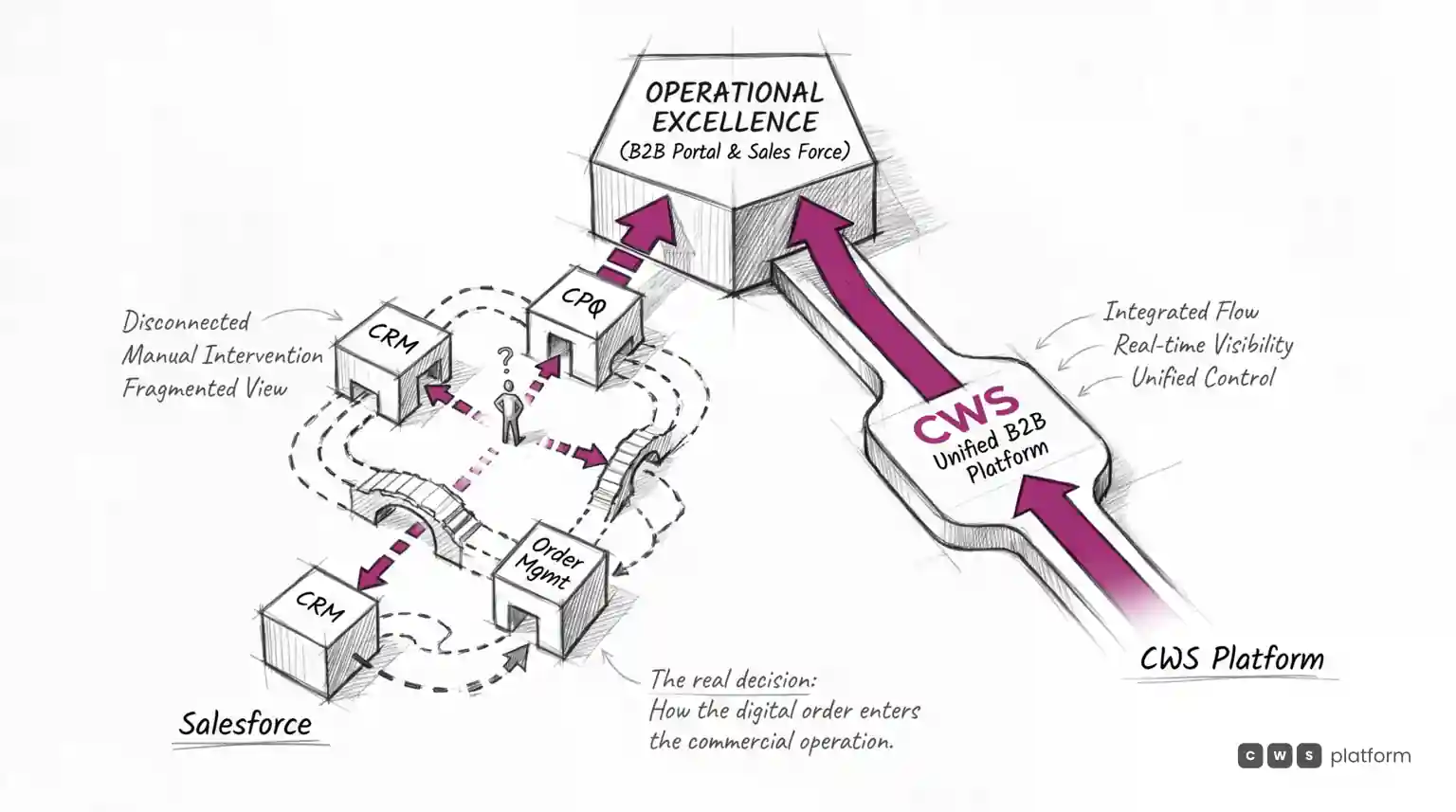
Salesforce vs. CWS Platform: Which Architecture Helps a B2B Portal Sell With Your Sales Team?
This comparison examines how Salesforce and CWS Platform connect a B2B portal to sales operations. The key question is where account context, pricing, approvals, credit, and order governance live.
Read →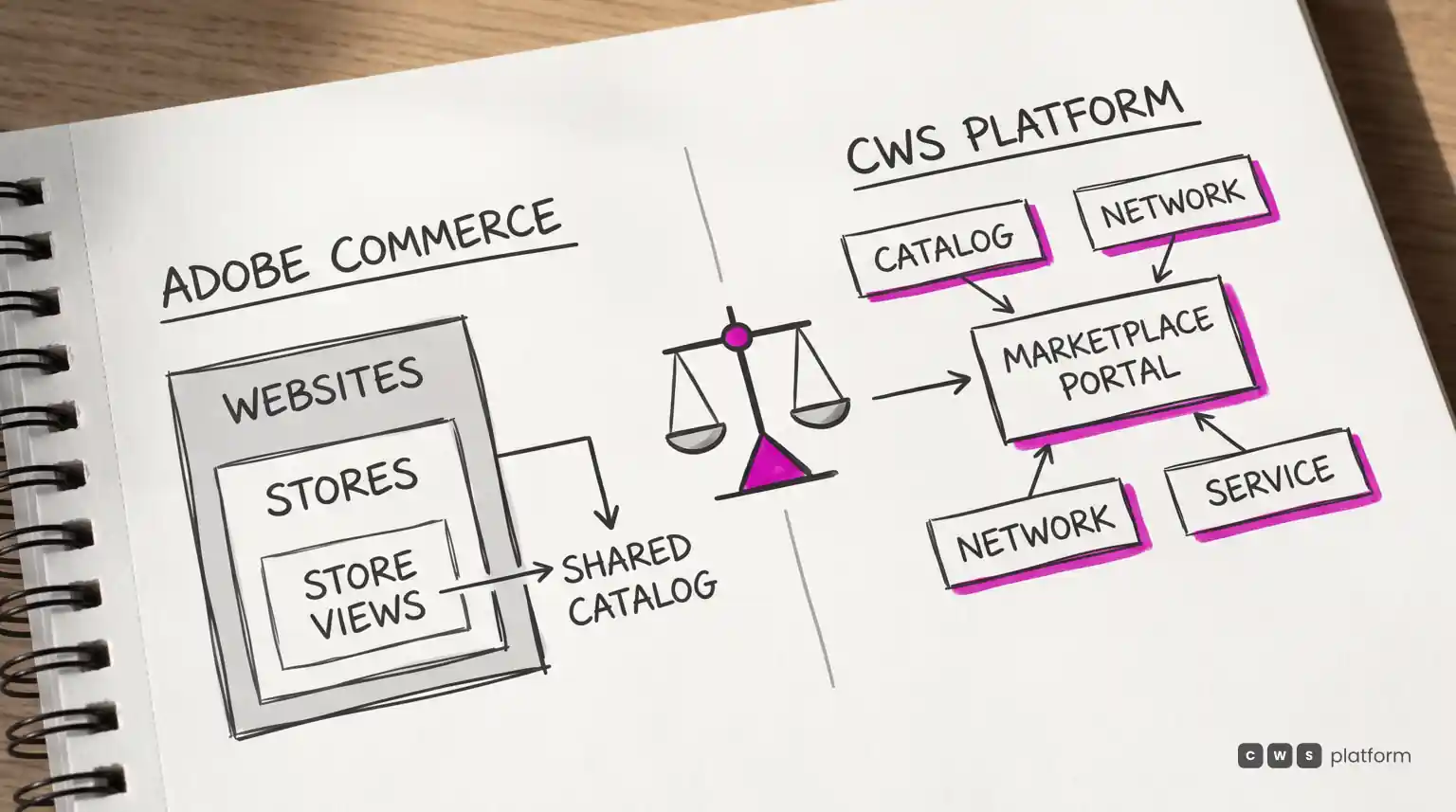
Dealer Marketplace: Adobe Commerce or CWS Platform for Catalog, Network, and Service Operations?
This comparison examines how Adobe Commerce and CWS Platform structure fitment data, regional dealer preference, assisted selling, and multi-source orders.
Read →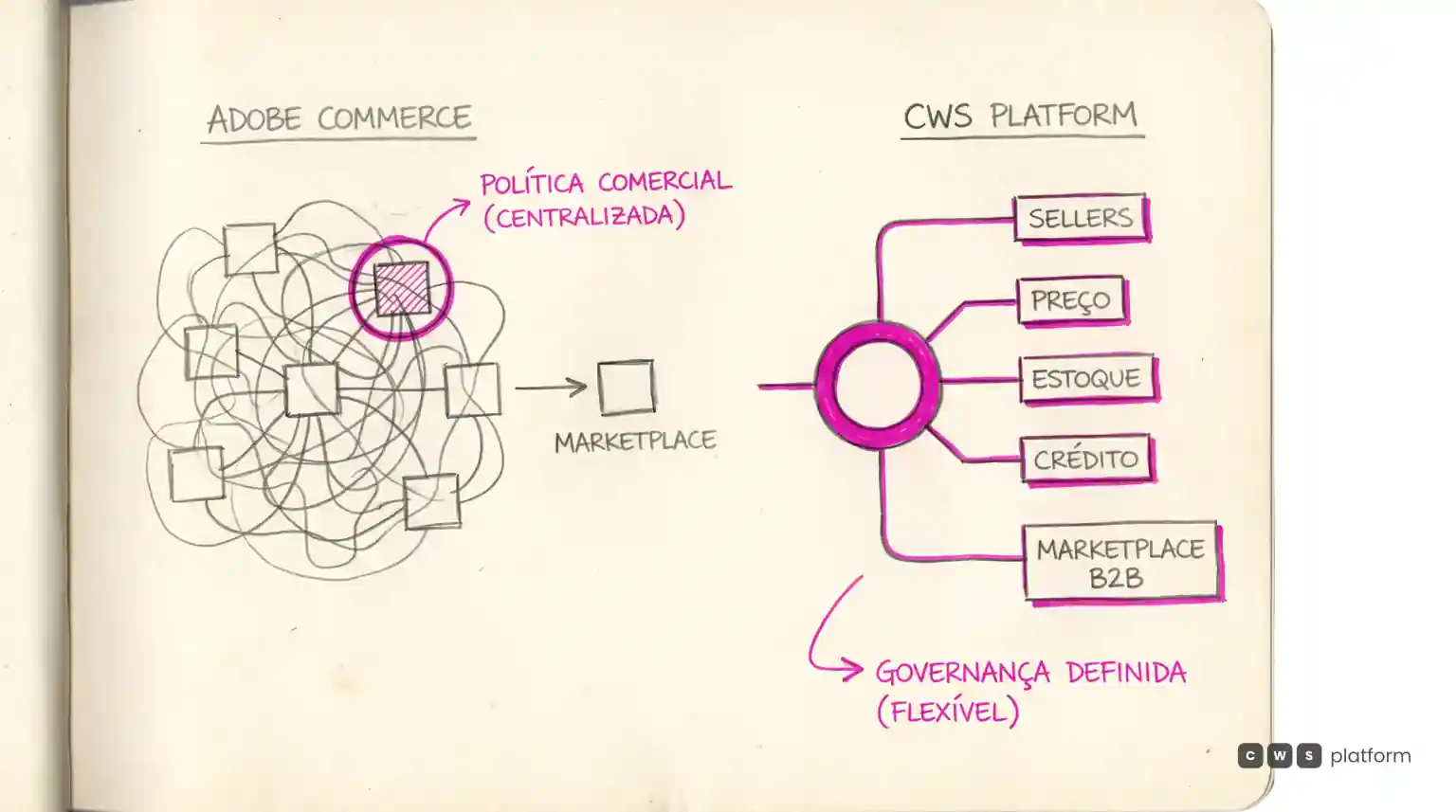
Adobe Commerce vs. CWS Platform: What Architecture Does a B2B Marketplace With Sellers Require?
This comparison examines how Adobe Commerce and CWS Platform structure commercial policy for a B2B marketplace with independent sellers.
Read →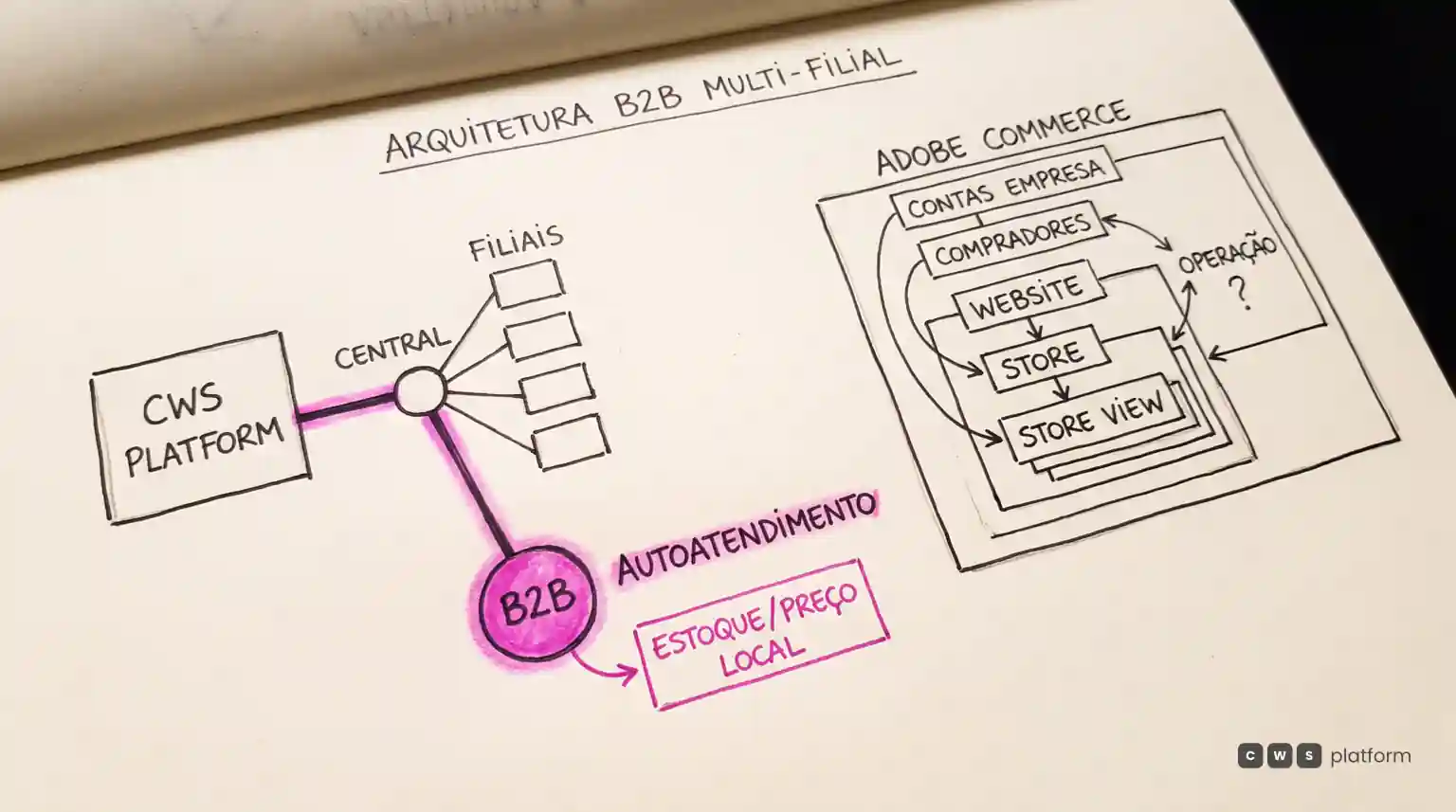
Which Architecture Keeps Location-Level Inventory and Pricing Accurate in B2B Self-Service?
This comparison examines how CWS Platform and Adobe Commerce handle locations, inventory, pricing, identity, checkout, and reordering in a B2B portal.
Read →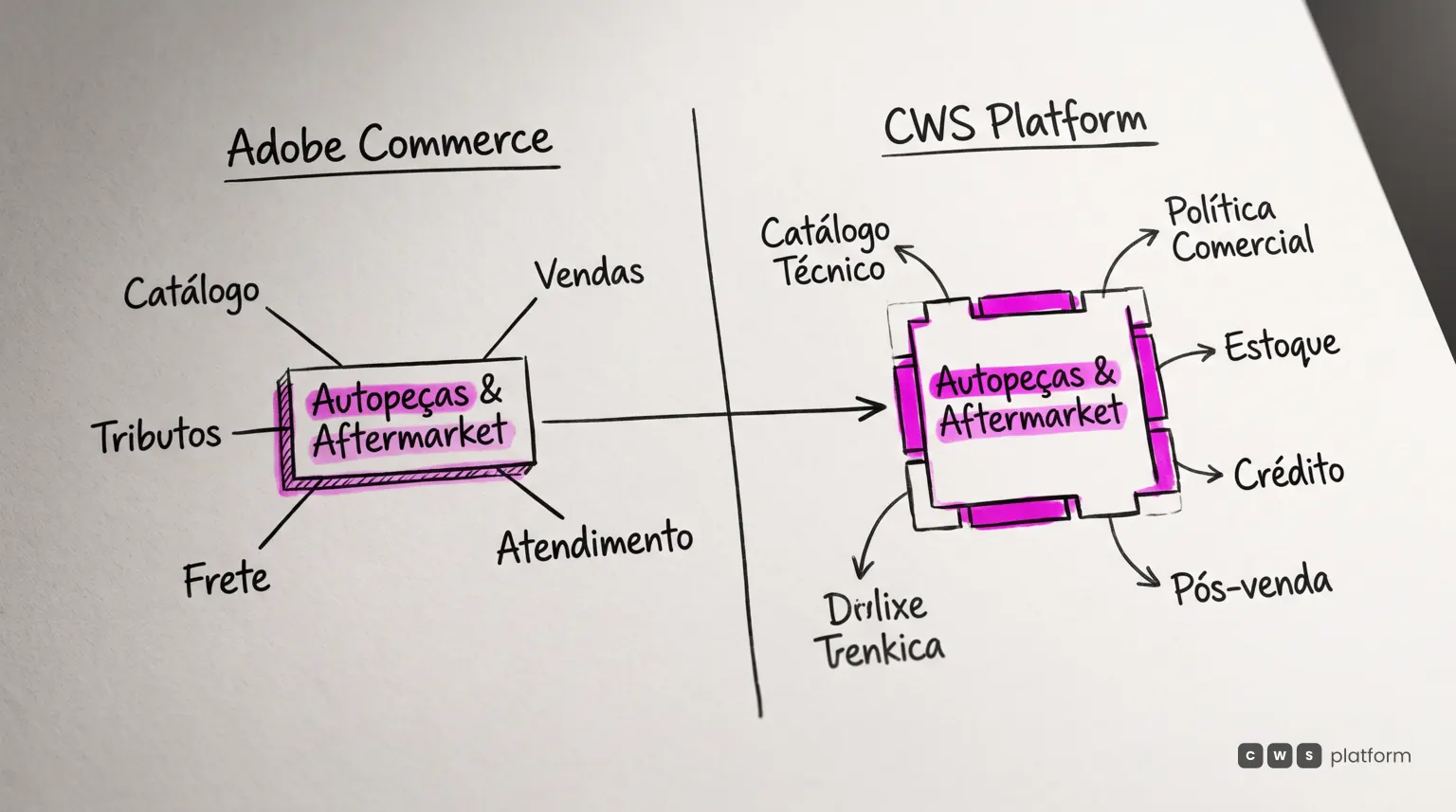
Adobe Commerce vs. CWS Platform: Which Architecture Does Auto Parts Distribution Require?
Adobe Commerce and CWS Platform organize B2B complexity around different architectural units. This comparison examines the impact on part discovery, negotiated pricing, order execution, and margin.
Read →
Adobe Commerce vs. CWS Platform: Who Does the CEO Depend On?
Adobe Commerce and CWS Platform create different forms of dependency. The comparison shows whether change sits with engineering, the ecosystem, the vendor, or business operations.
Read →
Adobe Commerce vs. CWS Platform: Where Should Replenishment Policies Run in a B2B Procurement Marketplace?
For recurring contract purchases, the storefront is not the core decision. The key question is where commercial policies run and how each order reaches fulfillment in a consistent state.
Read →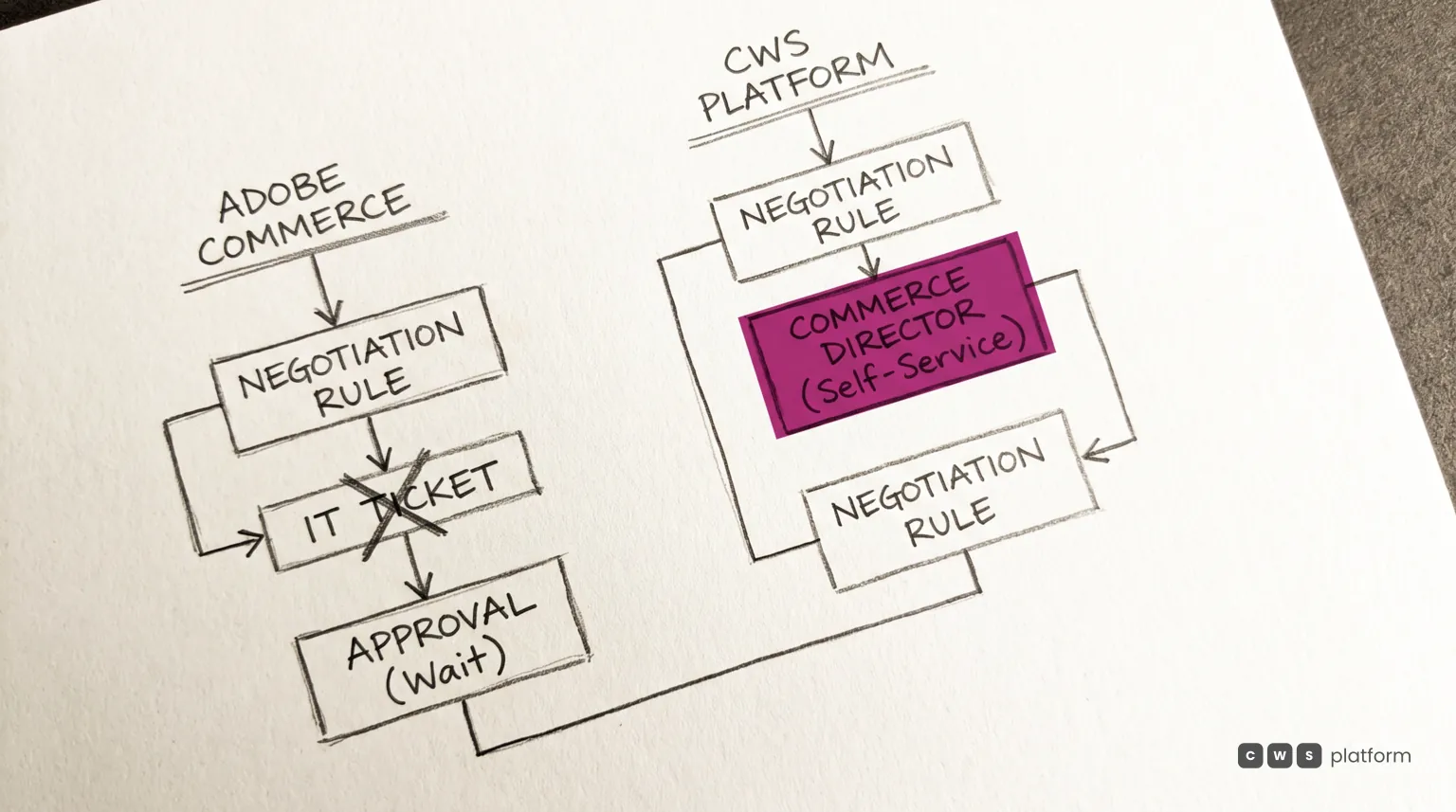
Adobe Commerce vs. CWS Platform: Can You Change a Negotiation Rule Without Opening a Ticket?
A head-to-head architecture comparison between Adobe Commerce and CWS Platform through the lens of a Director of Commerce: who turns a negotiated term into an executable rule, who can change it, and how that change reaches the order.
Read →
How to Cut the Cost of Every Recurring Contract Order Without Losing Procurement Control
A B2B supplies marketplace doesn't start with the storefront — it starts with the procurement policy that already exists. We compare how Adobe Commerce and CWS Platform execute contracted pricing, approvals, credit, and inventory on every repeat order.
Read →
B2B Portal Meets Counter and Field Sales: Adobe Commerce vs. CWS Platform, Side by Side
A head-to-head architecture comparison for distribution leaders who own marketing and channel revenue: Adobe Commerce's assigned pricing via shared catalogs versus CWS Platform's pricing calculated at the moment of sale. Including the four scenarios where Adobe Commerce is the right call.
Read →
Seven Questions That Separate B2B Commerce Architectures
Your RFP scorecard doesn't separate vendors because every platform answers 'yes' to the same questions. These seven questions surface the difference that would otherwise show up eighteen months in: whether commercial logic lives inside the platform or outside it.
Read →